
 RSS Feed (xml)
So, it's been pretty hectic recently so I haven't exactly been able to put 100% into everything, which is why I believe I've had quite an amount of trouble. I had no problems visualizing washers, shells etc, but I have to brush up on the mechanics of the applications. Some were simple, but i basically forgot it because I will admit, I haven't studied for the last few days. I tried, but too many things have been coming up which I can't say as it's quite personal. I actually kinda had some problems with the density and had trouble understanding it but I think I got the gist of it.
I hope I do alright and MacGyver it tomorrow. I'm actually cramming right now while trying to finish a bunch of other homework, so I'll see how it all goes.
Showing posts with label Applications of Integrals. Show all posts
Showing posts with label Applications of Integrals. Show all posts
Tuesday, March 17, 2009


Applications of Integrals Bobbbbb
Hey guys, I guess its that time of unit again. To talk about all the little finicky bits and the easy bits and the ones you liked and didn't like and all that stuff.
So since I'm super tired, I'm kinda gonna cut to the chase, so I can get all my z's haha.
SO overall I found the unit wasn't to bad. I understand the concept of taking a slice of whatever your looking at, analyzing it, and applying what you understand about that slice to the rest of the solid.
I'm finding the hardest part to generally be figuring out what the solid looks like and what exactly the question is asking. I also tend to forget some bits of the question (like when dealing with washer problems, I sometimes forget to subtract the inner circle :P)
Anyways the final verdict, this unit wasn't that terrible, although it wasn't my favourite either.
K, well I'm off to sleep, good luck tomorrow everyone!
~Ciao
So since I'm super tired, I'm kinda gonna cut to the chase, so I can get all my z's haha.
SO overall I found the unit wasn't to bad. I understand the concept of taking a slice of whatever your looking at, analyzing it, and applying what you understand about that slice to the rest of the solid.
I'm finding the hardest part to generally be figuring out what the solid looks like and what exactly the question is asking. I also tend to forget some bits of the question (like when dealing with washer problems, I sometimes forget to subtract the inner circle :P)
Anyways the final verdict, this unit wasn't that terrible, although it wasn't my favourite either.
K, well I'm off to sleep, good luck tomorrow everyone!
~Ciao
Scribe Meets BOB!
Pre-Test: Applications of Integrals
View more presentations from k_ina.
Yes, so I'm going to input my BOB in the same post also! So here I go!!! Also, what the heck is that ugly bar on my front slide? Oh well, whatever. I'm just glad slideshare finally worked.
Anyways, I thought this unit was pretty hard to grasp at first, especially the rotation parts. I couldn't see how they made the washers and shells at first but after doing lots of practice with them, I can see the patterns! They're beautiful by the way. Yes, so the pre-test also gave me some confidence for the test tomorrow since I did pretty well. Although, I kind of blanked out and couldn't finish my long answer. I basically just left the integral but didn't go on with solving for k. Silly me, har har. I won't do it for the test though.
As for the hardest parts for me. It is definitely the density stuff like that Boston by the Sea question we took so long to finish. Although I'm still kind of iffy, I think I'll manage.
Yeah, so in case you didn't look through the slides, the next scribe is Lawrence.
And to follow with the recently started tradition, here's a youtube video. I'm in a massive nostalgia stage right now, heck, I even watched the first episode of the first Power Rangers again when I got home today. Great stuff man. Anyways, here's my contribution...its a bit of what's to come...if you catch my drift >_>
BOB on Applications of Integrals
At first I thought this unit was going to be quite easy going, but to my surprise, or my demise it became quite confusing and difficult.
We started out by just finding simple distance and displacement given a specific scenario or problem, sure this was easy but then we moved to revolving 2d graphs.
In my opinion these graphs have no business revolving whatsoever. This was just confusing. We revolved these graphs on various points all over the plane, and certain points caused the shape to be a washer or cylindrical shell which required a few more calculations.
Good luck on the test everyone. I'm off to bed.
We started out by just finding simple distance and displacement given a specific scenario or problem, sure this was easy but then we moved to revolving 2d graphs.
In my opinion these graphs have no business revolving whatsoever. This was just confusing. We revolved these graphs on various points all over the plane, and certain points caused the shape to be a washer or cylindrical shell which required a few more calculations.
Good luck on the test everyone. I'm off to bed.
BOB The Builder indeed. BOB the Integrator.
It's me, .:. J + ME .:. and I'm sorry guys, for coughing up what seemed to be BOTH of my lungs during the pretest. It's awkward doing that when everything is quiet. **facepalm** I guess the stress is really catching up to me. I'll try to get Halls or Fisherman's Friend or something. I don't know why, but I just get sick when it starts getting warmer. I'm fine during the winter. Everything about me is backwards. I even read backwards most of the time. :S
Anyhoooooo. Back to business. **cough**. I think for me, this has been the unit that took me the longest to understand. The beginning was easy, it was direct integrating, and was understandable. But when 3D shapes are coming from 2D areas rotating around the cartesian plane, things get a little more complicated.
I think what was the hardest for me was trying to figure out which method to use, and the fact that I didn't quite understand why things were being done. I mean, I understood how to find the volumes and why the "patterns" were structured that way, but there are those word problems that I seem to have trouble with. It's like I understand how to do it, yet, I get stuck somewhere. I can't seem to finish one whole question like that without someone holding my hand, even if I'm almost on the last step. I also tend to make A LOT of errors. I'm a whole error . haha. But yes. That's me.
As for what I was saying earlier, I sometimes read the problem and it doesn't seem to click in my mind what I'm trying to find. It's like I'm going in circles. Mr. K says it's easier to know what we're trying to figure out with a diagram, but most of the time, I draw it incorrectly. That's what I've been working at for the past few days, and I know I should have done it earlier, but there are just too many things going on in my head right now. I'm not trying to make excuses, and I'm sorry if my non-responding vessel seems to bug you, Mr. K. I'm trying.
But yes, just like other tests, I only have a sliver of confidence in me, and so far, from what my marks are probably saying, I'm a "failure"...but it still doesn't stop me from trying to go up. :)
But yes, like all of my other posts, this one seems to be droning on, so I shall cough my way back into the textbook and slides on the blog.
Anyhoooooo. Back to business. **cough**. I think for me, this has been the unit that took me the longest to understand. The beginning was easy, it was direct integrating, and was understandable. But when 3D shapes are coming from 2D areas rotating around the cartesian plane, things get a little more complicated.
I think what was the hardest for me was trying to figure out which method to use, and the fact that I didn't quite understand why things were being done. I mean, I understood how to find the volumes and why the "patterns" were structured that way, but there are those word problems that I seem to have trouble with. It's like I understand how to do it, yet, I get stuck somewhere. I can't seem to finish one whole question like that without someone holding my hand, even if I'm almost on the last step. I also tend to make A LOT of errors. I'm a whole error . haha. But yes. That's me.
As for what I was saying earlier, I sometimes read the problem and it doesn't seem to click in my mind what I'm trying to find. It's like I'm going in circles. Mr. K says it's easier to know what we're trying to figure out with a diagram, but most of the time, I draw it incorrectly. That's what I've been working at for the past few days, and I know I should have done it earlier, but there are just too many things going on in my head right now. I'm not trying to make excuses, and I'm sorry if my non-responding vessel seems to bug you, Mr. K. I'm trying.
But yes, just like other tests, I only have a sliver of confidence in me, and so far, from what my marks are probably saying, I'm a "failure"...but it still doesn't stop me from trying to go up. :)
But yes, like all of my other posts, this one seems to be droning on, so I shall cough my way back into the textbook and slides on the blog.
BOB
So this chapter was rather difficult for me to grasp. More difficult than usual actually. It took me a really long time to understand revolving an area around the x and y axis for some reason. The washer questions were the worst for me too. Now at the end of the chapter I feel very comfortable doing those. The questions i'm still iffy with are the square cross section or triangle ones. I know Mr. K always says to draw a diagram and work with a sample area. I just find it really difficult drawing the diagram. So yes....those parts I will study more tonight.
BOB Version 8: Applications of Integrals
The first section of the chapter, integrating velocity/speed to determine displacement/distance, was a breeze. Then rotating graphs came along... We learned how to take a function, integrate it, and then revolve it around the x-axis, revolve it around the y-axis, revolve around y=-1, and revolve it up the wazoo! Hopefully, no one's going to ask me how to revolve it around a parabola because I don't know how--a possible DEV question?
The visualizing of the washer and our quest in search of the hole took a lot of time for me to wrap my head around. Determining the integral of a function that's rotated around a line besides the x- and y-axis kinda messed me over in the pretest, but I managed to re-learn some of it thanks to the collaboration.
But when The Mean Value Theorem of Integrals came along, it was like a break from all this revolving and rotating, which made my head revolve and rotate too, not in the literal sense.
I realize I have to emphasize working more on the density problems since when Mr.K said "this should be a gimme!" it wasn't really a gimme as of yet.
You have reached the end of my BOB.
The visualizing of the washer and our quest in search of the hole took a lot of time for me to wrap my head around. Determining the integral of a function that's rotated around a line besides the x- and y-axis kinda messed me over in the pretest, but I managed to re-learn some of it thanks to the collaboration.
But when The Mean Value Theorem of Integrals came along, it was like a break from all this revolving and rotating, which made my head revolve and rotate too, not in the literal sense.
I realize I have to emphasize working more on the density problems since when Mr.K said "this should be a gimme!" it wasn't really a gimme as of yet.
You have reached the end of my BOB.
BOB for the Application of Integrals
Hi everyone,
This is my BOB.
This unit was quite interesting. I never would have thought that you could rotate anything on a Cartesian Plain. The first few sub-chapters on rotation around the x and y axes were quite tough at first. I couldn't see what was going on. But later on I began noticing how the solids would look like. Then when it came to calculations, imagining one sample slice of that solid made it easier to create an integral to find the Volume of the solid.
The last sub-chapters on the density-related functions were the hardest part of this chapter. I didn't do the homework that I was asked to do because of other priorities (Sorry Mr.K) but I did read a bit in the text which helped me understand a bit. I am certain that there will be at least one question that is related to this sub-chapter on the test and AP exam.
That is my BOB and good morning.
This is my BOB.
This unit was quite interesting. I never would have thought that you could rotate anything on a Cartesian Plain. The first few sub-chapters on rotation around the x and y axes were quite tough at first. I couldn't see what was going on. But later on I began noticing how the solids would look like. Then when it came to calculations, imagining one sample slice of that solid made it easier to create an integral to find the Volume of the solid.
The last sub-chapters on the density-related functions were the hardest part of this chapter. I didn't do the homework that I was asked to do because of other priorities (Sorry Mr.K) but I did read a bit in the text which helped me understand a bit. I am certain that there will be at least one question that is related to this sub-chapter on the test and AP exam.
That is my BOB and good morning.
Monday, March 16, 2009
Just found out that I'm the scribe for today sorry for the delay!!!
We suppose do the pre-test to day, but we are confused at certain type of question so we continued on this question:


This is the homework from Friday.

Use trapezoid sum to answer this question part a.

For part b, u basically just plot the graph out and u find it's constant at 1 to 8 so it's a straight line there the equation is -7.5r=82.5.
0 to 1 is also constant no change in slop so it's 75.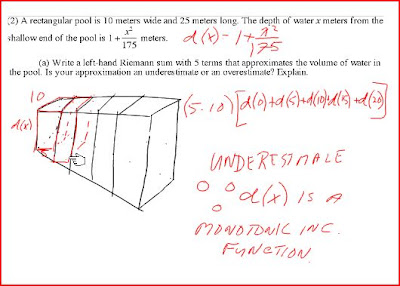
The 2ND question: draw the diagram 1st.
each one is 5 units away so it's d(0) to d(20).
then you add all of them up, it's underestimate you can tell from the graph.
I didn't really remember what we had went through in class.
Couple things to remember for this unit.
* always take a piece out of the whole solid, no there it's a disk or shell.
*dx is always means something, don't just put it in because u have to.
some helpful links to help review for the unit test:
http://www.intmath.com/Applications-integration/Applications-integrals-intro.php
http://www.mecca.org/~halfacre/MATH/appint.htm
http://education.yahoo.com/homework_help/math_help/problem_list?id=minicalcgt_6_1
hope this helps!!!!
the rest of the slides are home works to practice.
By the way next scribe is ........Kristina..............
We suppose do the pre-test to day, but we are confused at certain type of question so we continued on this question:


This is the homework from Friday.

Use trapezoid sum to answer this question part a.

For part b, u basically just plot the graph out and u find it's constant at 1 to 8 so it's a straight line there the equation is -7.5r=82.5.
0 to 1 is also constant no change in slop so it's 75.

The 2ND question: draw the diagram 1st.
each one is 5 units away so it's d(0) to d(20).
then you add all of them up, it's underestimate you can tell from the graph.
I didn't really remember what we had went through in class.
Couple things to remember for this unit.
* always take a piece out of the whole solid, no there it's a disk or shell.
*dx is always means something, don't just put it in because u have to.
some helpful links to help review for the unit test:
http://www.intmath.com/Applications-integration/Applications-integrals-intro.php
http://www.mecca.org/~halfacre/MATH/appint.htm
http://education.yahoo.com/homework_help/math_help/problem_list?id=minicalcgt_6_1
hope this helps!!!!
the rest of the slides are home works to practice.
By the way next scribe is ........Kristina..............
Friday, March 13, 2009
Not Paul After Work But Before Pi Day Scribe Post EXTRAVAGANZA (oh and we did some math or something)

Digital Ethics: Or How I Learned To Start Worrying And Think About My Online Identity
So today as usual we did our little “AP Exam Practice Quiz.” This one was, in my opinion, easier than the earlier ones because half the quiz was just about the 1st and 2nd derivative (I note though that I got these questions wrong too so hah).
The aforementioned questions are these:

So the first question is just asking you for local minimums. Just by looking at the graph, we can sort of rough out a sketch of the original function f (shown here in red). And that’s all we really need! Just by looking at our rough sketch we can say the original function f has local minimums at f = 5 and f = 0. Remember, we’re talking local not global minimums. In fact, unless your graph is always decreasing or something, your bound to have min/maxes at the beginning and end of a graph. Good thing to remember.

In this question, things get even easier. A local max or min on the first derivative is a critical number on the second derivative. 0 and 5 dont work, but 2 and 3 sure do. 2 is an inflection point, although not a local max because the second derivative keeps increasing. 3 is where the second derivative hits a local max and starts going downwards (decreasing).

If anything, this would be the trickiest question, because you have to remember the relationship between Velocity, Acceleration and Position. Velocity is the anti-derivative of Acceleration, and Position is the anti-derivative of Velocity. Remember to use the given values to find C so your equation matches the ones given. Otherwise, a cakewalk. Remember, Physics and Calculus are almost the same thing, seeing as Calculus was developed to advance Physics.

This is all stuff we should know. Anti-deriving, use of the Fundamental Theorem, algebra. If you’re really stuck or lazy, your graphing calculator can even do the question for you. Math, 0 is the equation solver. Either input the equation into the solver directly or put it in the graphing variables then select Vars, Y-Vars, Y1. Let it do its magic. Seriously Mr. K, in the future we’d like to know this sooner.
Either before or after the Practice Quiz, Mr. K also had a little bit more of a talk with us about Digital Ethics and our online identity. He reminded us that nothing “disappears” on the internet, and that online, what goes up stays up. He reminded us to keep in mind how the content we create now will always be there and to be mindful of how that content will be perceived in the future.
Mr. K even suggested that a great graduation present would be our own domain name, which I totally agree with. Comon! http://paulsantos.com/ isnt even taken yet!
Anyway, after that we continued work on the Greater Boston question. We determined that this question was different in a few ways, namely:
- That we cannot use the Fundamental Theorem because delta r cannot be changed. Since we cannot make r infinitely small, we cannot integrate it, and we have to use a Riemann sum.
- That we should “integrate” from 1 to 8 instead of 0 to 8 because the value doesn’t change from 0 to 1. Instead, we'll just add that extra population.
- That unlike our previous cylindrical shells questions, we’re dealing with half a shell not a whole shell.
The class ran out of time, and so we were left to ponder the population of Greater Boston by the seashore another day.
The homework was the remaining questions for 8.5 as well as finishing the Greater Boston question.
Happy Pi/Pre-Test day guys, see you tomorrow. Jamie, cant wait for your cheese cake. As a reward for making such delicious food, I pass the scribe torch onto you.
And some extra value added content to make this scribe post a delicious and nutritious part of your daily scribe serving:
Falcon Pawnch:
Good night guys. Hopefully I'll wake up in time to pick up some delicious blueberry pie.
Thursday, March 12, 2009
Wednesday, March 11, 2009
Boston Bay problemmmsss
Okay so I was all ready to do this scribe post, and then I discovered, I left all my notes at school :[ SO basically all my diagrams are not here with me (atm) and I have to solve alot of the more finicky bits of the problems myself. Yay me! :[
Anyways enough griping, what we did today. To start, we had another little quiz. I'm not really quite fond of these things, although I suppose they're good tools for both Mr.k's and our own assessment of where each individual student is/how well they're doing in the course. As usual we had four questions, and this happened to be one of the no calculator varieties.
So onward with the first question.

So in this question, your given the graph of f(x) and asked to find some information (specifically, which of the 5 points f'(x) < 0 and f''(x)> 0. This for the most part is testing to see if you know what the first and second derivative tell you about the parent function (namely that the first derivative tells you weather the parent function is increasing or decreasing, and the second tells concavity.) Knowing this we find that solving the problem is a simple matter of looking at the concavity around the point, and if at that point on the parent function, it is increasing or decreasing.
Second question

This question 100% wont be on the exam
Why?
Because it's way to simple to be on the exam.
quote endquote of the conversation involving this slide. Pretty much, you just do the red in the picture, take the value of f(x) at 4, subtract is from the value of f(x) at 1, then put that over 4 - 1, then voila. answer. (in this case 4/3)
Neeexxxttttt

This question was also somewhat easy. If you read through the question properly you'll find it's just a direct application of the chain rule. Simply follow the values on the chart, plug em in, and away you go.
FINAL LAP!
dundun dundundun dundeedee!

SO, this one turned out to be a related rates sort of question. The first step here was to write the formula for the volume of a sphere, then differentiate that. Then, you simply begin plugging in some values (namely, a value smaller then 1 and one bigger then one) What you find is that with values of r smaller then 1, the sphere decreases in size, and that with values of larger then 1, the sphere increases in size. Turns out, this is one of the answers. yippee :]
Okay so this is where it gets kinda foggy, so please bear with me guys D:

So this question here, is basically a continuation of the stuff we were doing yesterday, with the funky density questions and the latter rho (whoa Iknorite?). Benchmen showed us the light with this one, so props to him for that goodness.
So in part a.) we need to write a function which will give us the number of cars. We know that the function given describes the traffic in terms of cars/km. To find cars we need to multiply this my Delta km (change in km.) Now as bench said we're actually trying to get really small changes to Delta km ends up ad just dx. (As Shown on the slide)
After all that we put it back together, and find that to find the number of cars, you just do this. (its kinda hard to explain in words so I just cropped it xD)

The next bit of the question (aka. part B.) goes something like this.

Quite simply, all you do is evaluate over the interval 0 to 30 (since you have 30km of road your working with.)
Alrighty guys, its not time for the post titled, BOSTON BAY PROBLEMMMM
dum dun dundundundun.

Now, instead of tackling this whole thing at once, lets start with just part a (or what we started of it anyways before the class ended D:)

So, from what I can tell by looking at the blog, we got as far as setting up the units, (aka, out delta whatever, that becomes the dx.) I'm pretty sure it was around this time the bell rang, and we got our homework and things.
Okay everyone hopefully that wasn't a nightmare to follow, if it was, I apoligize, thats what I get for forgetting my books -_-;
So ja, the next scribe is Paul because I havent picked him in awhile lol.
Ciaooooo
edit: Btw, homework is 8.5 6-10 and the rest of the boston bay problem :]
edit edit: Soo I couldn't leave without some goodness haha

Anyways enough griping, what we did today. To start, we had another little quiz. I'm not really quite fond of these things, although I suppose they're good tools for both Mr.k's and our own assessment of where each individual student is/how well they're doing in the course. As usual we had four questions, and this happened to be one of the no calculator varieties.
So onward with the first question.

So in this question, your given the graph of f(x) and asked to find some information (specifically, which of the 5 points f'(x) < 0 and f''(x)> 0. This for the most part is testing to see if you know what the first and second derivative tell you about the parent function (namely that the first derivative tells you weather the parent function is increasing or decreasing, and the second tells concavity.) Knowing this we find that solving the problem is a simple matter of looking at the concavity around the point, and if at that point on the parent function, it is increasing or decreasing.
Second question

This question 100% wont be on the exam
Why?
Because it's way to simple to be on the exam.
quote endquote of the conversation involving this slide. Pretty much, you just do the red in the picture, take the value of f(x) at 4, subtract is from the value of f(x) at 1, then put that over 4 - 1, then voila. answer. (in this case 4/3)
Neeexxxttttt

This question was also somewhat easy. If you read through the question properly you'll find it's just a direct application of the chain rule. Simply follow the values on the chart, plug em in, and away you go.
FINAL LAP!
dundun dundundun dundeedee!

SO, this one turned out to be a related rates sort of question. The first step here was to write the formula for the volume of a sphere, then differentiate that. Then, you simply begin plugging in some values (namely, a value smaller then 1 and one bigger then one) What you find is that with values of r smaller then 1, the sphere decreases in size, and that with values of larger then 1, the sphere increases in size. Turns out, this is one of the answers. yippee :]
Okay so this is where it gets kinda foggy, so please bear with me guys D:

So this question here, is basically a continuation of the stuff we were doing yesterday, with the funky density questions and the latter rho (whoa Iknorite?). Benchmen showed us the light with this one, so props to him for that goodness.
So in part a.) we need to write a function which will give us the number of cars. We know that the function given describes the traffic in terms of cars/km. To find cars we need to multiply this my Delta km (change in km.) Now as bench said we're actually trying to get really small changes to Delta km ends up ad just dx. (As Shown on the slide)
After all that we put it back together, and find that to find the number of cars, you just do this. (its kinda hard to explain in words so I just cropped it xD)

The next bit of the question (aka. part B.) goes something like this.

Quite simply, all you do is evaluate over the interval 0 to 30 (since you have 30km of road your working with.)
Alrighty guys, its not time for the post titled, BOSTON BAY PROBLEMMMM
dum dun dundundundun.

Now, instead of tackling this whole thing at once, lets start with just part a (or what we started of it anyways before the class ended D:)

So, from what I can tell by looking at the blog, we got as far as setting up the units, (aka, out delta whatever, that becomes the dx.) I'm pretty sure it was around this time the bell rang, and we got our homework and things.
Okay everyone hopefully that wasn't a nightmare to follow, if it was, I apoligize, thats what I get for forgetting my books -_-;
So ja, the next scribe is Paul because I havent picked him in awhile lol.
Ciaooooo
edit: Btw, homework is 8.5 6-10 and the rest of the boston bay problem :]
edit edit: Soo I couldn't leave without some goodness haha

Tuesday, March 10, 2009
Circular oil slicks.........
The class started off with our daily quiz that will prepare us for the ap exam later on. The quiz for today consisted of 4 questions:

After the quiz, we proceeded to where we left off last class. By drawing a diagram we see it is like a cylindrical shell kind of question. The question is what is the mass of the oil slick. In the question, they give us density per metre squared so we'll have to multiply an area function. The area function we'll be using will be a circle since they said it was a circular oil slick. So if we err unrolled a portion of the washer we'd end up with a trapezoid. By moving one of the triangles at the side we can make a rectangle. The area of a rectangle can be found by l x w. And there is our area function.

The question wants 75 percent of the mass which is 3255. So now our integral isnt going from 0 to 1000 but to some value r since we want the smallest possible. This will give us an accumulation function that we'll equal to 3255. To find r we can use our calculator to find intersections or bring everything to one side and find roots.
Yes....another scribe post finished. "virtual memory is low" Good thing I finished before my computer died. Anywho HOMEWORK is 8.5 1-5. Next scribe will be ughh the person who said he wanted to beat up my clone...yes you Justus.

When both degrees on the numerator and denominator are the same we can just take the leading coefficients and divide them. Doing it the long way would not be recommended since we only have 2 minutes to do each multiple choice question.
This is a classic ap exam question on the multiple choice. Mr. K assured us it'd be on there sooo everyone make a mental note. The way it was written is just to throw us off. All it is asking for is the derivative of cos(pi/2), which is -1.

This question was made easier for us because it was already is in its factored form. So by knowing the roots of the derivative we know the critical points. Using the 1st derivative test we see that a number less than 1 will give us a negative result and a number greater than 1 will give us a positive. Therefore, by the first derivative test there is a min at 1.
I thought that this was the hardest question in the quiz. It helps a lot to just have a feel of what the graph of it would look like. This is an accumulation function so the derivative is always the underlying function. Plugging in 0 into x we get that the derivative does equal 5 at 0. By doing the 2nd derivative test we see that the result will always be negative so therefore it is concave down.

After the quiz, we proceeded to where we left off last class. By drawing a diagram we see it is like a cylindrical shell kind of question. The question is what is the mass of the oil slick. In the question, they give us density per metre squared so we'll have to multiply an area function. The area function we'll be using will be a circle since they said it was a circular oil slick. So if we err unrolled a portion of the washer we'd end up with a trapezoid. By moving one of the triangles at the side we can make a rectangle. The area of a rectangle can be found by l x w. And there is our area function.

The question wants 75 percent of the mass which is 3255. So now our integral isnt going from 0 to 1000 but to some value r since we want the smallest possible. This will give us an accumulation function that we'll equal to 3255. To find r we can use our calculator to find intersections or bring everything to one side and find roots.
Yes....another scribe post finished. "virtual memory is low" Good thing I finished before my computer died. Anywho HOMEWORK is 8.5 1-5. Next scribe will be ughh the person who said he wanted to beat up my clone...yes you Justus.
Monday, March 9, 2009
Evaluating the Value of the Intermediate Value Theorem of Integral Values
Hi everyone,
I almost forgot to scribe, but thanks to a friend I remembered.
Today we had an AP Multiple Choice Practice Quiz. It contained 4 multiple choice questions and calculators were allowed. Beforehand Mr.K calculated the average time a person has per question on the calculator section of the multiple choice questions. We had approximately 12 minutes for the 4 questions.

Above is the first question. It is a Linear Approximation question. These type of questions require you to find the equation for the tangent line that is tangent to a point on a function. Then use that line to approximate the derivative of a nearby input. So to find the equation of a line, you need a point which is given and a slope (derivative at that point) which is also given. So place the numbers into the Point-Slope form of a line, with the derivative as a slope and the coordinates as xo and yo accordingly. Then using that new line equation input 3.02 into the line function and solve.

The second question involved understanding the term changing direction when given a velocity function. In a displacement function a change in direction would mean the function is increasing then decreasing or vice versa. So when a displacement function is increasing the derivative is positive and when it is decreasing the derivative is negative. So that means the change in direction can be found where ever the derivative function crosses the x-axis (has a zero). Most of the class had a problem on this question because we were not paying attention to the interval.

The third question involved our good friend, the Mean Value Theorem of Derivatives. The Mean Value Theorem says that if you make a secant line connecting the endpoints of a continuous and differentiable function in a closed interval, there is at least one other point on the function that has the same slope as that secant line. So the first step in solving this problem is to find the slope of that secant line. Find that is simple, find the change in f(x) and divide by the length of the interval. Now that you have the slope, differentiate the given function and set it equal to the slope of the secant line. We do that because we are trying to find another x-value that has that slope. So just solve for x and you have an answer.

The last question involved Implicit Differentiation. Implicitly Differentiate the given algebraic equation, remembering that derivative of a constant is 0. Now solve for y'. To find y' we need an x-value. To find that plug the given y-value into the given equation and solve for x. Now plug the given y-value and the newly discovered x-value into the differentiated function and solve for y'. Now you have the answer.
After that little quiz, we continued on the Intermediate Value Theorem of Integrals. The theorem says that on a continuous function, f, within a closed interval, [a,b] there exists an input between a and b, such that the signed area under the function, f,is equal to the area of the rectangle under the line, f(c), between a and b. I don't know if that is the right way of saying it, but that is how I see it. Correct me if I am wrong. I hate doing this but here is the formula...
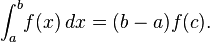
So we use that theorem to find the value of c in the following slides.
The final slide has a problem involving the Fundamental Theorem of Calculus. It says that if you integrate a function from a to b, the answer is the change in value of the function, f(b) - f(a). So that makes sense, we are given a rate of change, and in this case the rate at which oil is leaking. So when we integrate the function for the first 10 hours we get a number, and that number represents how much oil has leaked out.
That is it. Watch the video at the end of the slides for a little review on the Mean Value Theorem.
We will be continuing our discussion on the Intermediate Value Theorem of Integrals tomorrow, I believe.
Next Scribe will be Joyce. (Sorry for the confusion on my last scribe post)
Good Night and may the force be with you.
I almost forgot to scribe, but thanks to a friend I remembered.
Today we had an AP Multiple Choice Practice Quiz. It contained 4 multiple choice questions and calculators were allowed. Beforehand Mr.K calculated the average time a person has per question on the calculator section of the multiple choice questions. We had approximately 12 minutes for the 4 questions.

Above is the first question. It is a Linear Approximation question. These type of questions require you to find the equation for the tangent line that is tangent to a point on a function. Then use that line to approximate the derivative of a nearby input. So to find the equation of a line, you need a point which is given and a slope (derivative at that point) which is also given. So place the numbers into the Point-Slope form of a line, with the derivative as a slope and the coordinates as xo and yo accordingly. Then using that new line equation input 3.02 into the line function and solve.

The second question involved understanding the term changing direction when given a velocity function. In a displacement function a change in direction would mean the function is increasing then decreasing or vice versa. So when a displacement function is increasing the derivative is positive and when it is decreasing the derivative is negative. So that means the change in direction can be found where ever the derivative function crosses the x-axis (has a zero). Most of the class had a problem on this question because we were not paying attention to the interval.

The third question involved our good friend, the Mean Value Theorem of Derivatives. The Mean Value Theorem says that if you make a secant line connecting the endpoints of a continuous and differentiable function in a closed interval, there is at least one other point on the function that has the same slope as that secant line. So the first step in solving this problem is to find the slope of that secant line. Find that is simple, find the change in f(x) and divide by the length of the interval. Now that you have the slope, differentiate the given function and set it equal to the slope of the secant line. We do that because we are trying to find another x-value that has that slope. So just solve for x and you have an answer.

The last question involved Implicit Differentiation. Implicitly Differentiate the given algebraic equation, remembering that derivative of a constant is 0. Now solve for y'. To find y' we need an x-value. To find that plug the given y-value into the given equation and solve for x. Now plug the given y-value and the newly discovered x-value into the differentiated function and solve for y'. Now you have the answer.
After that little quiz, we continued on the Intermediate Value Theorem of Integrals. The theorem says that on a continuous function, f, within a closed interval, [a,b] there exists an input between a and b, such that the signed area under the function, f,is equal to the area of the rectangle under the line, f(c), between a and b. I don't know if that is the right way of saying it, but that is how I see it. Correct me if I am wrong. I hate doing this but here is the formula...
So we use that theorem to find the value of c in the following slides.
The final slide has a problem involving the Fundamental Theorem of Calculus. It says that if you integrate a function from a to b, the answer is the change in value of the function, f(b) - f(a). So that makes sense, we are given a rate of change, and in this case the rate at which oil is leaking. So when we integrate the function for the first 10 hours we get a number, and that number represents how much oil has leaked out.
That is it. Watch the video at the end of the slides for a little review on the Mean Value Theorem.
We will be continuing our discussion on the Intermediate Value Theorem of Integrals tomorrow, I believe.
Next Scribe will be Joyce. (Sorry for the confusion on my last scribe post)
Good Night and may the force be with you.
Friday, March 6, 2009
Subscribe to:
Posts (Atom)