
 RSS Feed (xml)

Well I don't know about you but that test was quite tough. It was our first test with Mr K back. For me, the hardest part of that test was with the local linearizatioin question just because we didn't do that much work on it. I don't know about you but I noticed that there was no related rates question. I was bracing myself for a related rates question, at least a shadow and lamppost one but there wasn't one.
Well I want to know how everybody else felt about the test? What questions did you think were hard? Easy? Comfortable with? Scared of? I guess you can make a post to the blog or just post a comment. I just want to know how you felt about the test so we can all work together to clear up our muddy points.
It is your choice if you want to comment or not. But it will benefit you in many ways instead of sitting and writing the next test or exam sweating....
Showing posts with label Derivative Rules. Show all posts
Showing posts with label Derivative Rules. Show all posts
Wednesday, November 26, 2008


Monday, November 24, 2008
Let's Differentiate BOB
It seems like I keep saying the same thing over and over again...It seems like I think I really get the concept, and then when we're supposed to apply it, I don't.
I understand how to find the related rates of sums, finding the approximations, which is kind of similar to the previous concept of Riemann sums, and I understand the laws that we've learned through the book. BUT the main thing for me, which makes everything go awry, is that I don't recognize the pattern, as Mr. K mentioned earlier. When it comes to solving a problem I have a hard time analyzing it and determining which rule or method to use. So that's something that could probably be solved with practice, which I tried by doing some exercises tonight, but honestly, it's not looking so good.
As well as that, one thing I'm still finding foggy is how to draw a derivative and how to determine which direction the function is growing... without using an actual function. I have a feeling I should know this by now, but I really don't know it to the core and I still have a lot of trouble with that. Also for some reason I really have trouble finding the derivative of a function the long way now, since I can't seem to get rid of the h in the general form of f ' (x) = f (x + h ) - f (x) / h
Because I don't quite know this, I feel... sort of.. left behind. But somehow I'll get there.. I hope.
Differentiating the BOB
Okay, this is going to be the first test with Mr K back. It's been a big jump from having Dr.E for 2 months then returning to Mr K. This Differentiating Rules unit is pretty easy as far as differentiating functions go.
That part is clear as crystal. The muddiest part of this unit is by far the Related Rates of Change part. At first I was at about 30% at understanding it, when Mr K came back and got us to do some questions on the Related Rates, I went up to about 70% understanding. But still I am unsteady on the related rates of change. I can't seem to apply the right work and differentiation rules. Just like what Mr. K says, a major part of math is to see a pattern. I haven't fully recognized the patterns in these types of questions. So I will accept Mr.K's prescription for this problem. I have to take 2 tablets of questions, 3 times a day, for 1 week (So to speak).
For local linear approximation, it's a new subject to me so it is a bit tough, but that is due to me not working on enough questions. This part of differentiation is much easier than the Related Rates of Change questions.
That is my BOB for the Differentiation unit. Hopefully I reach that 100% mark on the Related Rates of Change Questions.
Good Night
BOB, it's a test.
Well, its that time again, when we have a test and we have to call upon BOB. Today I didn't think the pre-test was going to be all that difficult, but it was. I thought it was gonna be a breeze because I felt that I knew what was going on about those word problems Mr. K kept giving to us in class, but the pre-test wasn't that simple. I totally forgot about the other stuff that we learned about before Mr. K arrived. Now I need to study pretty hard to try and remember the problems and rules and stuff. I also need some practice on those word problems. I'm sort of worried, but I'll just look back at what I have and try my best. Good luck everyone.
Chapter 4 Pre-test (and BOB)
Well in today's class there was a small debate about whether or not we heard the day we are having a test on a Tuesday (tomorrow) or on a Wednesday (November 26). So we came to a conclusion to have the test on Wednesday, since many of us heard it was on that day. Then right after we had a pretest, after a couple of moments we were split up into groups. In the group that I was in we had quite a bit of trouble figuring out who had the right answers and so on, and there where questions where I had doubted some of my answers.
Nearing the end of class Mr. K managed to go over some of the questions with us.
Question 1
In a very bad video format, where some words are cut off and etc...
( I was experimenting with this program)
Question 2
For this question all you need to do is use the quotient rule so there is not much explination in here.
Question 3
Here in this question, I'm still a little bit iffy on it, because I can't see how you find the derivative of a numeral, so if possible can someone explain to how do you find a derivative in a numeral form?
And up to here we ran out of time to finish the rest, I'm sorry if this isn't a very detailed post since I had some confusing questions to deal with >>;; So please don't shoot.
~~~~~~~~~~~~~~~~~~~~~~~~~~~~~~~~~~~~~~~~~~~~~
BOB
Well as you can see in the first part of this post I had some difficulty with some questions, but the biggest challenge to me is the chain rule... I don't really like the chain rule sometimes because it can get pretty messy and ugly fast. However that is not the only thing, I think I need to work on the questions (forgot what they are called) involving change of (insert x here) over the change in time. Plus I need to figure out how to find a derivative using numerals... Good luck on the test everyone!
Finally the next scribe will be Jamie!
PS: Since I'm gone for my road test during class on Wednesday, is it okay if I write the test during my lunch hour?
Sunday, November 23, 2008
Friday's Scribe
I am the scribe for Friday and sorry for saving this till the last day..but I'm here now!
Anywho, we started off the class with a rates of change question in which we were split into three groups. The question was incredibly long to read and it was about a dingo?..named Wallaby. Instead of explaining the question to you, here it is!
Willy the Wallaby is a hard worker, but not devoted enough to work at the circus for almost 70 hours building a tank just so he could be shot out of a cannon like a metal ball. He is convinced there is a better job out there (and he wants to at least keep a shred of dignity). So Willy joins up with his friend Roo and his old coach Spike to seek out a tough guy name Wyman Weasel who has been sending out letter for a covert employment operation offering great pay for the ones with enough "guys and smarts" to find the secret hangout. The instructions began at the intersection of Crime Dr. and Twotough Blvd. The streetlight on that corner is 36 ft off the ground. The only ones who can get the job have to figure out the rate they have to be moving toward the south end of Crime Dr. in order to have their shadow changing length at a rate of 11/35 ft/sec. Once the applicant found the rate, the next instruction was to move at that pace and an escort will approach. The escort will take any animal that moves at the right pace to the clubhouse door. The final password to get in is the rate of change of the tip of the shadow. Willy and his friends want your help to finally get the good paying job they deserve. Find the rate Willy and his friends must move if they are all 4 ft 6 inches tall, and then find the rate of change of the tip of the shadow.
OKAYYY!! First, let's draw a handy dandy diagram. Its important to get the visual first when doing these types of questions to see what you're working with.

Now, we are given the rate the shadow, s, is moving, which is 11/35. We also know the height of Wallaby and his pals, which is 4'6, convert that 6 there into feet and we got 4.5, as shown in the diagram. We now have all the given elements to this question and we are asked to find the rate Willy and his friends are to move with that given height, in other words, we are looking for dd/dt. The second part asks for the rate of change of the tip of their shadows, so the last piece to this puzzle would be da/dt.
From there, we can then take a closer look at the diagram. Notice the relationship between the bases of the two triangles compared to a. That's right!
 We can also derive the derivatives from that relationship in respect to time. Now with that, we can then move onto the the next inspection of the diagram. There are similar triangles, so let's make our ratio and solve for the rate of change of d.
 If you're wondering how we went from line 2 to line 3, we basically just multiplied both sides of the equation by 36 so that it is easier to solve for dd/dt. This also helps save time, since on the exam, we are only given about 15 minutes to solve these questions (We took more than 30 mins to solve it in class XD).
Alright! Now that we have the dd/dt, we can now solve for da/dt. All we have to do is put dd/dt and ds/dt back into the equation dd/dt + ds/dt = da/dt. Voila, we're done! You've now successfully helped Willy and friends :D!
Now, the next part of class consisted of us trying to find the root, using Newton's Method (x0 was -0.5) for the function:
f(x) = x + sinx - 2x + 1
Let's simplify this first...
f(x) = sinx - x + 1
Find the derivative next which is...
f'(x) = cosx - 1
Now we can use Newton's method to find x1. If you don't remember, the formula for Newton's method is as followed:
 Using it is as simple as it looks like. Take the negative of x0, in this case it is -0.5, and divide that by the derivative of x0. Then add x0 to that to get x1. As you can probably see, it doesn't equal zero, so we have to keep going. Instead of using x0, now you use x1. If that still doesn't equal zero, then you keep going with x2 and so on till you get zero.
Mr. K also taught us how to use Newton's method using our calculators.
-First you have to graph f(x) into Y1.
-Then, you graph f'(x) into Y2.
-Now 2nd QUIT and press VARS, Function, Y1.
-Put an open bracket from there and input the value for x0.
-Close the bracket, then press STO-> (above the On key) and then Alpha A. This stores that value into A.
Go back to step 2, instead of going to Y1, go to Y2. The rest is the same till the last step, you'll be pressing Alpha B instead to store it into B. We've now got all our elements needed to solve using a calculator.
From there, first press the negative button and then Alpha A. Now divide that by Alpha B. Then add -0.5. Yippee Kayeeh! You've now found x1 using your calculator! Now repeat the steps using the consecutive x values found till you get it to equal zero!
*Pants* Alrighty now, the test is on Wednesday! Be sure to get your BOBs out by then. Also, if you haven't done it by now, Chapter 4.7, questions 11-22 ODD...I believe. Okie dokes, I am done. Oh yeah the next scribe is ...........Yinan. Have a nice day. =)
Thursday, November 20, 2008
Approximations
We started learning the stuff on 4.7 in the book, which was about approximations. We learned how to approximate using the tangent lines and Newton's method. Curves are difficult to approximate so we use derivatives.
The class however started with us solving these root questions:
square root of 9
square root of 8
square root of 36
square root of 37
The only ones important were square root of 8 and square root of 37 because they aren't perfect squares and we can't approximate it exactly.
This is the root x function, which is the positive half of a sideways parabola.
The class however started with us solving these root questions:
square root of 9
square root of 8
square root of 36
square root of 37
The only ones important were square root of 8 and square root of 37 because they aren't perfect squares and we can't approximate it exactly.
This is the root x function, which is the positive half of a sideways parabola.

y-y1=m(x-x1).

First we need the slope at the point (9,3). So we find the derivative of the curve at that point which is it's slope. Using the power rule we find the derivative is (1/2)x(-1/2) . After plugging in 9 in x we get the slope at that point is 1/6. Now we have all the variables needed to make the equation.
y-3=(1/6)(x-9)
f(x)=(1/6)x+(3/2)
Now that we have the equation of the tangent line we can use it to approximate the value when x=8 because the tangent line touches near it. After plugging in 8 in the function above we get the number 17/6. To see how close our approximation was we find the difference between the 2 values. (17/6)-square root of 8 = 0.0049. This is called the error.
It is the same process to find the value of square root of 37. We found out though that the error is much smaller. It's because the derivative of the tangent is decreasing as the x values increase. The derivative of the tangent is called the 2nd derivative, which is pretty much the slope of the slope.
Some other facts:
-The approximation will never be below the real value
-because graph is concave down
-the tangent line will always be above the curve
Newton's Method
I've been dreading explaining the beast that is called Newton's Method all day. As Mr. K says there's a difference between long and hard? Well I'm not going to quote him on that but he says something along those lines. I'll just do a little intro to it and leave the rest for the scribe tomorrow to carry on XD.
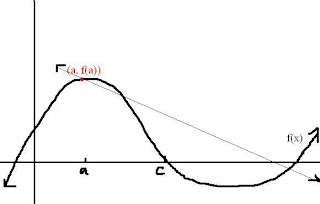
ANYWAYS, suppose we have a function that looks like the one below and we want to find its root.

First we make an estimate at a point near the root like at (a, f(a)). Just like how we solved square root of 8 with tangent approximations, we use that process here. Imagine that as a tangent line not a secant line =( .
y-f(a)=f prime (a)(x-a)
(plugging in the points in the point slope formula)
0-f(a)=f prime(a)(x-a)
(since we're looking for a root, y=0)
(-f(a)/f prime (a))+ a = x
We can see that our approximation is no where near the root of the function. So we have to make another tangent line on the function where there was a root on the tangent line. You repeat this process until you eventually get closer to the root.
I know my explanation of Newton's method sucked but i tried :(. Doing my scribe just made me realize how much i miss our smartboard
Next scribe is Kristina.
Wednesday, November 19, 2008
5-foot Girl and her Shadow...
Okay so today in class was a pretty fun one. We started with a problem: A light is at the top of a 16 foot pole. A girl, 5 feet tall walks away from the pole at a rate of 4 ft/sec. At what rate is the tip of her shadow moving when she is 18 ft. from the pole? At what rate is the length of shadow increasing?
Okay so we tackled this question together. First we wrote out everything we had, and everything we need, thanks to the question we already had a rate to work from. Which was the rate at which the girl walked away from the pole, it was 4 ft./sec. We had the height of the pole: 16ft, and we had the girls height: 5ft. We need to find the rate when the shadow is moving and the rate of the length of the shadow as it increases. Let's draw out a diagram!

As you can see, that is a triangle, not just a regular triangle, it's a right angle triangle. Okay, but there are 2 triangles, and they happen to be similar, because they are proportional, just one is smaller, with smaller sides. Okay, we'll get back to that later, but for now we should write down our rates.

Our rates are in relation to time, because if there was no time, there would be no movement going on, and well we wouldn't have a moving shadow or girl without time.. right? We're given the rate of the distance covered by the girl which is 4ft./sec, so our first rate is equal to 4. Our second rate is the rate at which the shadow is moving and our final rate is the rate of the length of her shadow as it increases. Now, all the letters such as "d", "s" and "a" are given by our diagram. From our diagram, we got "a" from adding together d and s (d + s = a, pay attention to this equation, we're going to use it later on). We should find some ratios, because the triangles in the diagram are similar (refer to diagram), we know that side "s" is to 5 ft. as side "a" is to 16 ft. s/5 = a/16, from this we know that 16/5 = a/s. We know that a is equal to d+s, now we just throw it in.

First things first, substitute a for d+s and rewrite the equation, then put like values on one side and solve by finding the lowest common denominator, etc. Substitute dd/dt with 4, because that's what we were originally given. simplify 4/16 to 1/4. Divide out 11/80 to finally find ds/dt, which is the answer to one of out questions! The rate at which the tip of the shadow is moving when the girl is at 18ft. away from the lamp post.
Now that we have ds/dt and dd/dt, we can solve for da/dt.

That was the answer to our last question, the rate the length of her shadow is increasing.
We also learned a little jig for the Quotient Rule, we rehearsed it a few times so feel free to practice. It goes like this: lo - di- hi minus hi - di - lo all over lo - lo. Where hi is the numerator of the given function, lo is the denominator and di is short for derivative.
Last thing we did in class was similar to the question we got in the beginning, but I'm not sure what it was about, because we didn't have much time to work on it. I'm sure we'll go over it thoroughly next class though. But for now, my post is done! Next scribe will be Joyce.
Related Rates Homework
Read through this tutorial on related rates problems. It's a lot to read but it's worth your time. The beginning will take you through the general steps to take in solving related rates problems, then there are several examples that have animations to show you what is changing in the problem and how.
Here is another tutorial with animations and a problem set. You can do as many questions from the problem set as you like. You may also want to try the first 5 questions here. Answers are provided so see if you can solve them without looking at the answers. ;-)
All of that is just too get extra help if you need it. This is your homework:
The Three Questions:
(1) As a circular metal griddle is being heated, its diameter changes at a rate of 0.01 cm/min. Find the rate at which the area of one side is changing when the diameter is 30 centimeters.
Answer: 0.15π cm/min
(2) A stone is dropped into a lake, causing circular waves whose radii increase at a constant rate of 0.5 m/sec. At what rate is the circumference of a wave changing when its radius is 4 meters?
Answer: π m/sec
(3) The ends of a water trough 8 feet long are equilateral triangles whose sides are 2 feet long. If water is being pumped into the trough at a rate of 5 ft3/min, find the rate at which the water level is rising when the depth of the water is 8 inches.
Answer: (15/32)√(3) ft/min
Sunday, November 9, 2008
More Math Fun With the Benchmeister
***HINT: HOW MANY WAYS CAN YOU WRITE XX ***
Okay since we are on the derivative laws and rules part of our lives, I decided give you all a little problem to solve. Here it is:
Okay given (plus we know) that:
d
---- nx = nxn - 1
dx
d
---- ax = ax * ln a
dx
d
---- (u*v) = u * v' + v * u'
dx
d
---- ln u = u-1 * u'
dx
What is:
d
---- xx
dx
Okay since we are on the derivative laws and rules part of our lives, I decided give you all a little problem to solve. Here it is:
Okay given (plus we know) that:
d
---- nx = nxn - 1
dx
d
---- ax = ax * ln a
dx
d
---- (u*v) = u * v' + v * u'
dx
d
---- ln u = u-1 * u'
dx
What is:
d
---- xx
dx
Friday, November 7, 2008
Trig Derivatives and the CHAIN Rule
Well this is another scribe post by me benofschool, otherwise known as BenchmEn (I'm a plural Justus :P ). Anyways, Dr. E started off the class by introducing us with the derivative of sin(x) and cos(x) our good ol' fundamental trig identities. With the use of our trusty calcumuhlators, we saw that the derivative of sin(x) was cos(x) and cos(x) was -sin(x). What we did was plug the original function in Y1 and in Y2 we inserted the calculator program nDeriv(Y1, X, X). Now we added these two useful derivatives in our handy-dandy derivatives handbook.
The next derivative rule we looked at will be a useful tool in our handbook. It is known as the Chain Rule. Here is the rule (I'll explain soon...) :
d/dx [f(g(x))] = f ' (g(x)) * g ' (x)
Okay so to get this derivative, we first take the derivative of f(x) using keeping g(x) within the f function. We then multiply that result with by the derivative of g(x). Remember the chain rule may involve many layers of functions within functions. So the chain rule may involve the use of your whole arsenal of tools from your handy-dandy derivatives handbook. Also, the chain rule is derived from a number of different derivative rules.
Lets see the chain rule in use...
d/dx [sqrt(x3 + x)]
(x3 + x)1/2
What we first do is put the function in a way that we know how to work with, with exponents. Now lets take the derivative.
1/2(x3 + x)-1/2 * 3x2 + 1
So what I did here was to use the power rule on the original function. The exponent of the original function becomes the coefficient and the new exponent will be the exponent of the original function minus 1. The power rule requires to multiply that new function by the derivative of the function within the brackets. The function in the brackets is simply a polynomial and we've done those tons of time before. Power rule galore. Now lets finish it off
3x2 + 1
----------------
2(x3 + x)1/2
Since the polynomial in the brackets had a negative exponent we have to take the reciprocal of it or throw it into the denominator. Now it gives us the beast above. Algebra is such a beautiful thing. But remember the first line was quite ugly as well. So all we needed to do was algebraically massage the beast using our massaging tools that we have collected over the years.
That was our calc hour, homework is chapter 4.3 all odd numbers I believe (Kristina *ahem*) Speaking of Kristina!!! She won't be our next scribe, but Not Paul.
Good Night and remember Manipulation is a beautiful thing....
Pants are essential
Subscribe to:
Posts (Atom)