Showing posts with label joyce. Show all posts

Friday, April 24, 2009

Mini Exam 3

Thought I'd do my scribe early to make room for studying =(.


This was a gimme question. Very straight forward. We just have to apply the average value formula:


This was a washer question. Ah good times right? "I don't see the hole!" In washer questions we just subtract big radius squared from little radius squared and integratate. Don't forget your pi.


After simplifying we realize that the function is just a line. So we know I is true since the limit from both sides will be equal since this is a line. II is also true because f(a) is defined. III however is not true because x cannot equal a. So there's a hole in our line.


There was a little typo with the questions here. But it's all better now. The table gives us numerical values so that was a hint that we numerically find the derivative at 1.2. We do that by finding the slope from the left and right of 1.2 by using the f(x+h)-f(x)/h formula.


So we first start by cutting the graph up into 4 intervals. The ending time was 24 and they want it into 4 intervals so 24/4=6. So our intervals are 6 hours apart. To find a midpoint Riemann sum we use the middle value of the interval as the length of the rectangle and of course width is the change in time.

K that's it folks. I think this is my last scribe post =(. The exams getting closer so don't forget to do your three questions a day. Hope you guys are enjoying you're long weekend. Next scribe will be Yi Nan.

Wednesday, April 15, 2009

BOB

So this last chapter was a nice closing to the course. What I had trouble with this unit was separating the variables. It wasn't the calculus that was messing me up but the algebra. After doing a lot of questions with separating, I'm used to doing them now without making mistakes. Some other things that have been messing me up on a lot of questions is antidifferentiating. I know it should be a breeze but I just can't remember that darn + c. It looks like it just doesn't belong there XD.

K so studying for the next 2 hours. I really wanna do good for this last chapter :(

Tuesday, April 7, 2009

More Differential Equation Problems

Yeees....the day started off with a quiz just like old times.


So this was a familiar question, a related rates problem. All i remembered while writing this quiz was the steps in the book. Find your equation, which is the pythagorean theorem and differentiate all the variables with respect to time. They gave you the rate of change of x so all that is left is to...solve for dy/dx.


This question was a shell question. Revolving around the y-axis will give you a cylinder of some sort. You can take a sample piece of the cylinder and you'll end up with a rectangle. Then integrate the area of the rectangle. The length would be 2pir since the length is the part of the cylinders circumference. The width is the little change so it'll be dx. The height is equal to the difference between top and bottom (2 and e^x).


This question was straight application of the chain rule, which is just the derivative of the outer function multiplied by the derivative of the inner.


The answer for this one was none. To find the answer quickly we can use process of elimination. Or you can do the long way and derive each of the options...


So back to differential equation problems. What made this problem hard for me was figuring out the initial value. So you set it up the usual way by first finding your differential equation. It said that population of bacteria increased proportionate to the present population. That means the rate is just a constant multiplid by the present. Then all thats left to do is the algebra. The initial value will be 100% and will be 300% when the original population triples and 400% when it quadruples.

K homework is bee question also 2004 ap examp i believe. yeah yinan next scribe you.

Tuesday, March 17, 2009

BOB

So this chapter was rather difficult for me to grasp. More difficult than usual actually. It took me a really long time to understand revolving an area around the x and y axis for some reason. The washer questions were the worst for me too. Now at the end of the chapter I feel very comfortable doing those. The questions i'm still iffy with are the square cross section or triangle ones. I know Mr. K always says to draw a diagram and work with a sample area. I just find it really difficult drawing the diagram. So yes....those parts I will study more tonight.

Tuesday, March 10, 2009

Circular oil slicks.........

The class started off with our daily quiz that will prepare us for the ap exam later on. The quiz for today consisted of 4 questions:


When both degrees on the numerator and denominator are the same we can just take the leading coefficients and divide them. Doing it the long way would not be recommended since we only have 2 minutes to do each multiple choice question.


This is a classic ap exam question on the multiple choice. Mr. K assured us it'd be on there sooo everyone make a mental note. The way it was written is just to throw us off. All it is asking for is the derivative of cos(pi/2), which is -1.


This question was made easier for us because it was already is in its factored form. So by knowing the roots of the derivative we know the critical points. Using the 1st derivative test we see that a number less than 1 will give us a negative result and a number greater than 1 will give us a positive. Therefore, by the first derivative test there is a min at 1.


I thought that this was the hardest question in the quiz. It helps a lot to just have a feel of what the graph of it would look like. This is an accumulation function so the derivative is always the underlying function. Plugging in 0 into x we get that the derivative does equal 5 at 0. By doing the 2nd derivative test we see that the result will always be negative so therefore it is concave down.


After the quiz, we proceeded to where we left off last class. By drawing a diagram we see it is like a cylindrical shell kind of question. The question is what is the mass of the oil slick. In the question, they give us density per metre squared so we'll have to multiply an area function. The area function we'll be using will be a circle since they said it was a circular oil slick. So if we err unrolled a portion of the washer we'd end up with a trapezoid. By moving one of the triangles at the side we can make a rectangle. The area of a rectangle can be found by l x w. And there is our area function.


The question wants 75 percent of the mass which is 3255. So now our integral isnt going from 0 to 1000 but to some value r since we want the smallest possible. This will give us an accumulation function that we'll equal to 3255. To find r we can use our calculator to find intersections or bring everything to one side and find roots.

Yes....another scribe post finished. "virtual memory is low" Good thing I finished before my computer died. Anywho HOMEWORK is 8.5 1-5. Next scribe will be ughh the person who said he wanted to beat up my clone...yes you Justus.

Sunday, February 22, 2009

Chapter 8.1

Friday's class was supposed to be test day but plans change. No worries though, no time was wasted. We immediately started chapter 8.1. The class went through the chapter on that site mr. k said to go on. He was also right about the chapter being not so difficult. It was all about antidifferentiating velocity.

The only new stuff was total distance traveled. Our math book gave a good explanation of this. For example, if you take 5 steps forward and 3 steps back the net change would be 2, however the total change would be 8! So we learned to find total change we'd need to use absolute value sign. We also have to find the interval where the velocity is positive and negative and antidifferentiate them. We then add those them together to find the total distance.

Yes...that is my scribe post. Next scribe will be benchi-man. I'm not really sure what to tag this as...........

Thursday, February 19, 2009

Quick BOB!

K so the night before the test I find myself really irritated that I've been slacking off this chapter. After I looked through the slides, I realized that I was having trouble identifying which method (substitution or by parts) to use to antiderive. Solving the question is so much easier when you know which one to use. I especially need to work on all the mechanical stuff that Mr. K talked about before also. That's my bob for this unit...time to study.

Wednesday, February 4, 2009

DR. LUV

Okie dokie. The class started off with more problems with the substitution since everyone wanted a little more practice. I found it fun XD. The first problem was the same as yesterdays except we used a different "u". What I took out of this part of the lesson was...that solving these kinds of problems become very routine. They're all similar in the way you go about solving them.


Another big part of the lesson was the final answer. Mr. K emphasized that those meanies who make our exams don't include the pre massaged answers to select in the multiple choice. There's always an extra step. For example in this question, after finding the antiderivative our answer was:

2/5(x+3)5/2-2(x+3)3/2+C

However we need to do more with it. We must factor out the "lowest common factor" (i'm not sure what we called it...oops). For this question we can factor out a:

2/5(x+3)3/2

So that's what they'll usually put in the multiple choice answers for the exam!


We also started some new stuff called Integration by Parts. For these kinds of questions we used the product rule and algebraically massaged it to make a rule for antidifferentiating. Now that we have an antidifferentiating rule we can follow it and choose what we'll have as f and g'. The rule of thumb is to always choose the most complicated variable that is the easiest to antidifferentiate. All that is needed is to plug in the new values into the rule. However, bookkeeping is very important once again. Keep track of all the substitutions and the signs....or else.


For the next example, we did the same steps and everything. Only difference is what we chose f to be. g'=x2 because it is the easiest to antidifferentiate. (I got a little confused in this step thinking it was lnx that could be g'. But it can't since we don't know the antiderivative of it. I even had Mr. K fooled for like a full....20 seconds thinking the antiderivative for lnx=1/x, which it isn't.) Then all that is left to do is to plug in the values and voila. Oh and to factor out the "lowest common factor".

The only chit chat I remember today was Mr. K talking about some job called an...acc...something. I forget that too. But he says it's a really good paying job XD. Holy carp, since when did our scribe list get so tiiiny? ANYWAYS, next scribe will be Benchmen.

Monday, January 19, 2009

Last Minute BOB

I was just drifting off to sleep until my eyes shot open realizing I hadn't bobbed yet. Ths unit was really short and I like short units. Less things to absorb but it seemed like this chapter was jam packed with new things to understand. What really confuses me in this unit is all the underlying function talk. I get it and all but I have to think it through and say it to myself. I literally chant "the derivative of an accumulation function is the underlying function" to get started in solving a question. What Mr. K said today was really true about how it's all about understanding and not the calculation. I agree! So yeah and I do take this class because i like learning about math...but I like marks too :D.

Mr.K if i'm a little late tomorrow it's cuz my parent have some home inspection appointment tomorrow at 8:30 far far away.I have no way of getting to school other than my mama and papa. Yippee less time for me.

Tuesday, January 13, 2009

More Accumulation Functions

Today's class we revisited the nDerive program in our calculators. The program calculates the derivative of a function and graphs it. We also went through all the parameters but went in depth with the parameter h. The default value of h in our calculators is .01. It uses that value to calculate .01 units to the right and .01 units to the left. The bigger the h value becomes the less accurate it will be. However, by adding too many zeroes to the right of the decimal makes the calculator think the number is just plainly 0(thank you joseph for pushing your calculator to its limits).


We were also shown a new program in our calculators called fnInt (math 9 on calculator). This is able to graph an accumulation function. The slide above shows the parameters of the program. The default h value for this is .001 if I heard correctly. One thing we were told was to never write fnInt on a test EVEER. I'm surprised I've never done something like that on a test.


Then we found out there was more than 1 fundamental theorem of calculus. The 2nd fundamental theorem of calculus is displayed above. All it says is that the derivative of an accumulation function is equal to the original function f(x). An accumulation function is a function made from using the area under the curve. Like the previous example before using fnInt, we saw that the graph it created was the antiderivative of the function x. So the derivative of the accumulation function would be the original function...(in terms of the example the original function would be x) That shows a connection between derivatives and integrals. They are like multiplying and division or adding and subtracting. Differentiation and integration are inverses of each other.

In between the learning there was chit chat about scholarships, Mr. K's new house, and other things I unfortunately didn't write down =(. Anywho next scribe will be Paul or Not_Paul...whatever name you go by XD.

Saturday, January 10, 2009

J2K Timeline [SORRY FLJ for the letter stealing. At least we acknowledge our lack of creativity for the name and at least we used a number.]

Wow. Compared to Team FLJ, just wow. Sorry we had to ruin it by not having our own graphic and colour to this post, but at least the work is done. Or this part, anyhow.

Here's our timeline, also subject to change.

JANUARY 8: Making of timeline
COMPLETE

Record copied examples of questions for project reference. COMPLETE

  • Copying a rough draft of 6 questions from textbook/resources to use as references for the types of problems to use in DEV project; chosen based on difficulty we had with these questions so that we’d spend time learning on how to solve these problems.
JANUARY 20: Brainstorm on possible ideas for project to have more appeal for learning.

FEBRUARY 5: Continue brainstorming possible theme ideas and have made the decision on what to use.

FEBRUARY 6: Create 6 questions from reference problems.
  • Start the process of creating six of our own word problems that relate to a theme; using the type of questions we chose, with first, learning how to solve these problems.
MARCH 15: Have the majority of the 6 created questions solved.
  • Answer as many questions as possible and make sure that we're getting the right idea by using resources, such as asking other people, reading textbook, internet and asking Mr. K for greater understanding.
MARCH 20: Preparation of extra matierial.
  • This is for the "look" of the project, the part that will make it visually easier for people to learn the material. Basically getting aspects of the theme together using videos, slides, pictures etc, that abide by copyright rules.
APRIL 12: Finish answering and explaining questions.
  • By this time, hopefully we'll have all of the questions answered and explained thoroughly enough to be taught to readers of our project.
Media is cited and sourced ready to put into DEV.

APRIL 17
: Merging of all aspects of project for preparation of final structure.

MAY 1: Finalization, adding finishing touches getting ready for immediate publication on the blog.

MAY 2-3
: Submit to Developing Expert Voices blog as a big finale.

There's our timeline and we hope to follow it, and finish this ASAP.

Tuesday, January 6, 2009

BOB for Chapter 5

I knew i should've bobbed loooong time ago. The holiday break has really made me forget a lot of things but I've reviewed the past chapters and i'm regaining my memory. My muddiest point for this chapter is the optimization problems. It seems so simple with all the steps we were given but it just isn't. No topic has ever made me so frustrated. So the pre test we had yesterday was so so for me. I got the multiple choice ones but the long answer was harder. After Benchi explained that all i had to do was apply the 1st derivative test it became clear what I had to do from there.

KK we've postponed this test long enough and tomorrow is when we'll finally have to do it =(. Hopefully i'll do good. *prays*

Monday, December 8, 2008

More Optimization Problems

This class was focused on some more optimization problems.


By following the 6 step guide, it makes solving the problems a little easier.

Find the maximum volume of a right circular cylinder that can be inscribed in a cone of altitude 12 cm, and base radius of 4 cm, if the centres of the cylinder coincide.


Step 1)
The question tells us what to optimize, which is the volume.

Step 2)
We are optimizing volume so the formula for the volume of a cylinder is:

v=pir2h


Step 3a)
Through our picture of an inscribed cylinder in a cone, we see that we have similar triangles going on. So the height of the big triangle is proportioned to the height of the smaller triangle. As will the base of the big triangle be proportioned to the base of the smaller triangle, which is the radius of the cylinder.


Step 3b)
From this we can make the equation:


4/r = 12/12-h


From here, all we have to do is isolate one of the variables but we found out that there'll be less work if we isolate h. By isolating h we get :


h=12-3r


Step 3c)
After plugging in h into the optimization formula we'll get:


v(r)=12pi r2-3pi r3


Step 4)
We found the derivative of the optimization equation which is:

v'(t)=3pir(8-3r)


Step 5)
The critical numbers is when r=8/3. We also checked if this was a max by using the first derivative test.


Step 6)

We find the max volume by substituing 8/3 into r.Next Question.


So we always start with drawing a diagram first. From the diagram we can see that we have a triangle. X represents the point when he starts to walk. Using pythagoras we can find the hypotenuse, which is the distance of his boat ride. Then we can make a table of the values we know for distance, rate, and time. Time can be found by doing d/r. We have yet to find the optimization equation yet. What we need to minimize is the time. With the info in our table we can make a function t. The function t(x) is just the time he took to walk and row addeded together. Now all that is needed to do is to find the derivative and find critical points.


Yeah sorry this was kind of rushed but I've yet to eat dinner and I'm really hungry. As for scribe I'll pick Shelly. I know you said you were busy but I really don't know who hasn't scribed yet so yeah.

Tuesday, November 25, 2008

BOB for chapter 4

I'm feeling really comfortable with this unit. However, the pretest says otherwise. I just have a lot of trouble processing a question when I see it shown in a different way than what I'm accustomed to. Like on the pretest, when it asked for the derivative except was shown as a limit.

One of my muddy points would have to be the rate of change questions like everyone else. I know what you have to do to start off solving it by finding relationships. After that I just get stuck but I'll be working on these types of questions for the rest of the night.

Thursday, November 20, 2008

Approximations

We started learning the stuff on 4.7 in the book, which was about approximations. We learned how to approximate using the tangent lines and Newton's method. Curves are difficult to approximate so we use derivatives.

The class however started with us solving these root questions:

square root of 9
square root of 8
square root of 36
square root of 37

The only ones important were square root of 8 and square root of 37 because they aren't perfect squares and we can't approximate it exactly.

This is the root x function, which is the positive half of a sideways parabola.


To approximate root of 8 we use the closest perfect square to it, which is the coordinates (9,3). From that point we can make a tangent line. The purpose of the tangent line is to approximate the the point where x=8 on the curve. However, we only know the tangent line touches the point (9,3), which is on both the curve and the tangent. From this we can make the equation of the tangent line using the formula:


y-y1=m(x-x1).


First we need the slope at the point (9,3). So we find the derivative of the curve at that point which is it's slope. Using the power rule we find the derivative is (1/2)x(-1/2) . After plugging in 9 in x we get the slope at that point is 1/6. Now we have all the variables needed to make the equation.

y-3=(1/6)(x-9)


f(x)=(1/6)x+(3/2)


Now that we have the equation of the tangent line we can use it to approximate the value when x=8 because the tangent line touches near it. After plugging in 8 in the function above we get the number 17/6. To see how close our approximation was we find the difference between the 2 values. (17/6)-square root of 8 = 0.0049. This is called the error.


It is the same process to find the value of square root of 37. We found out though that the error is much smaller. It's because the derivative of the tangent is decreasing as the x values increase. The derivative of the tangent is called the 2nd derivative, which is pretty much the slope of the slope.


Some other facts:


-The approximation will never be below the real value

-because graph is concave down

-the tangent line will always be above the curve


Newton's Method


I've been dreading explaining the beast that is called Newton's Method all day. As Mr. K says there's a difference between long and hard? Well I'm not going to quote him on that but he says something along those lines. I'll just do a little intro to it and leave the rest for the scribe tomorrow to carry on XD.


ANYWAYS, suppose we have a function that looks like the one below and we want to find its root.


First we make an estimate at a point near the root like at (a, f(a)). Just like how we solved square root of 8 with tangent approximations, we use that process here. Imagine that as a tangent line not a secant line =( .
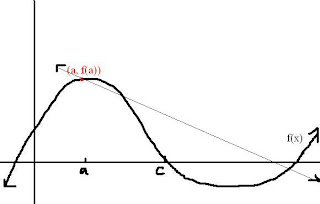


y-f(a)=f prime (a)(x-a)
(plugging in the points in the point slope formula)


0-f(a)=f prime(a)(x-a)

(since we're looking for a root, y=0)


(-f(a)/f prime (a))+ a = x


We can see that our approximation is no where near the root of the function. So we have to make another tangent line on the function where there was a root on the tangent line. You repeat this process until you eventually get closer to the root.


I know my explanation of Newton's method sucked but i tried :(. Doing my scribe just made me realize how much i miss our smartboard


Next scribe is Kristina.

Monday, November 17, 2008

The Ultimate Bob

I haven't BOB-ed in the longest time.

So our first unit was pretty simple even though I can't remember what we did. I do know it was some sort of...review. The second chapter is much clearer. The whole derivative concept took me a while to understand but all is good now.(Too bad I wasn't this comfortable with it a month ago) Looking back at that test I realized I made the stupidest mistakes and I should've done way better on it. Chapter 3 really clicked in my brain. I found it way simpler than the previous chapter and I understand it really well. Now for our current chapter. What confuses me here are the word problems. I have a hard time figuring out the relationships between the functions. All the other stuff like the rules I can become more comfortable with after some more practice.

Looking at my tests is super depressing but thanks Mr. K for cheering us all up today with your lecture and welcome back!

Wednesday, November 5, 2008

Differentation Rules

The class this morning started off with test corrections, which I really don't want to revisit.

The rest of the class was new stuff from chapter 4. This chapter is about the rules of calculating the derivative of a function in a faster way than what we've been doing from the last chapters.

Linear Function Rule

ie) f(x) = x
As we know, the derivative is the slope of the function. So the derivative of a straight line would always be constant since the slope does not change. In this example the slope of the function is 1, so f prime =1 (derivative of a linear function is always its slope).

Constant Function Rule

Constant functions are functions like y=1, y=2, etc. The derivative of a constant function is always 0 since there is no change in the slope.

Power Function Rule

The faster way of finding the derivative of a function without having to take smaller and smaller numbers from both sides.

ie) f(x)=x2

The rule is to take the exponent and multiply it to the coefficent and to subtract 1 from the original exponent to get the new exponent. So in this case we'd get 2x.

One other new thing was the d/dx symbol. It means the derivative of a function with respect to x.

I think those were all the rules we had time to go over but there's more in the book. The last scribe for this cycle will be Justus.

Sunday, October 5, 2008

Me and My TI-83.

In Fridays class, we explored the different ways of finding derivatives with our handy calculator.

On slide 2, we used the change in y / change in x to find the derivative. That method of course is where we find the slope of two points that are very close to the point we want which is where x =2.

On slide 3, the method we used is the quotient one. All we did with this question was to plug in 3 in x and chose 0.01 as our interval. From there we simplified and got the answer of 0.33. This is my favourite method for some reason. We also saw that we'd get the same answer with using the change in y / change in x way. After plugging in numbers like 2, 3, and 4 we noticed there was a pattern. The derivative for x=2 was .5, x=3 was .33, and x=4 was .25. Therefore, the derivative for ln(x) was 1/x.

From what we learned from Mrs. Karras, not all points are differentiable. The points that aren't are where the graph is....pointy! Like on the slide, the absolute graph is not differentiable at x=0. This is because the tangent slopes are -1 from the one side and 1 on the other side.

The other methods we learned were the dy/dx thing in our calculator and the nderive function in our calcs.

That's pretty muuuch it. *looks at scribe list.* The next scribe will be Yi Nan i suppose. Have fun scribing tomorrow. Now is time for me to enjoy the last hours of my weekend :(

Tuesday, September 16, 2008

Limits / Compound Interest

Sooo todays class started off with Dr. Eviator introducing us to her physicist/teacher friend who'll be filling in for her on days when she'll be absent later on.

The main things we did today were mostly some review on compound interest, logarithms, and limits. To explain limits, Dr. Eviator used compound interest as an example. The formula for compound interest is A(t)=P(1+r/n)nt. To make things simpler the variables r, t, and p = 1, the formula will now look like A(t)= (1+1/n)n. We found out that the more times the money is compounded the higher the interest will be. However there is a limit. After compounding more than 20,000 times, interest will not get bigger but instead decrease.

The rest of the class time was used to solve questions from the exercise books. Ha and Dr. Eviator was disappointed in the book because of how they solved a question with too much calculator graphing work :( and that's all i remember. NEXT SCRIBE IS BENCHMEN.