
 RSS Feed (xml)
This video reminds me of Mr.K's talks about technology and how it is evolving constantly:
Showing posts with label benofschool. Show all posts
Showing posts with label benofschool. Show all posts
Tuesday, June 16, 2009


Friday, May 1, 2009
3rd Last Class Before the Exam
WOW! Just 2 more classes until the big exam. That was very fast.
Today we reviewed Techniques of integration.
The first one we looked at was the U-Substitution technique. This can be used when you are antidifferentiating a function that is composed of a factor that is a composite function and the other factor is the derivative of the inner function of the composite function.

I did this question on the smartboard. First I chose a part of the function to be substituted for U. I saw that the denominator and the exponent of e was root x, so I chose that one.
So I let u equal root x and differentiated u as shown in the image above. I also solved for solved for x using the substitution, just in case I needed it. So I substituted all values necessary and I got an antiderivative. Great we found an antiderivative, how do we know if it correct? Just differentiated the antiderivative that you found and if you get the function that was to be antidifferentiated, then you got the right antiderivative.

This question is similar to the previous one but this one is an integral. What is the difference you ask? An antiderivative will give you a function, an integral will give you a number. Even though they are different, they are also related.
To answer this question, just antidifferentiate the function and substitute the limits into the antiderivative to find the answer. This is the definition of the second part of the Fundamental Theorem of Calculus.

Oh no! There is an antiderivative that we've never seen before. What is the antiderivative of cosecant, let alone the antiderivative of cosecant squared. I can't remember how we thought of this but Mr K got us to differentiate Cotangent. Using the Quotient Rule because cotangent can be written as cosine divided by sine as shown in the image above using abbreviations. Don't try to memorize the antiderivative/derivative relationship. Just understand that you can easily build it when needed.
Mr. K began talking about the antiderivative of x to the power of some number times e to the x. He said that it was a telescopic function which means as you evaluate it, the function will get longer, but things can be reduced or factored in such a way that it will shrink like a telescope.
I was playing around with some examples and I discovered the pattern. It is such a cool antiderivative. I'll give an example:

I got to this part by using integration by parts. So f = x³, my f' = 3x², g' = e^x, and g = e^x. Notice that the second term is still an antiderivative that we cannot find easily, but it is a factor of 2 functions, so let's use integration by parts again. So we'll get:

Once again we cant antidifferentiate one of the functions so let's integrate by parts once more:

Now we can finally evaluate that antiderivative. Once you do that you'll notice that there is a common factor of e^x. So let's factor that out and you might see something completely amazing. I'll show you:

Okay look at the polynomial in the brackets. When have you seen those specific terms before? If you think and look carefully the consecutive terms are derivatives of the previous term. I tried this again with another power of x and I got the same pattern. So when you are asked to find the antiderivative of x to the power of some number times e^x, the antiderivative will be e^x times the power of x in the function being antidifferentiated minus the derivative of the previous function until you reach a constant. Don't forget the plus c.

tn-1 means the previous term.
Sorry if my algebra was bad on the image above. But if you try it yourself, it really is a beautiful thing :P
The next few slides on the slide show posted by Mr K is for homework. Study for the exam on Wednesday. Next Scribe will be Francis.
Here is the video of the Scribe:
These guys have very funny podcasts.
That's all folks.
Today we reviewed Techniques of integration.
The first one we looked at was the U-Substitution technique. This can be used when you are antidifferentiating a function that is composed of a factor that is a composite function and the other factor is the derivative of the inner function of the composite function.

I did this question on the smartboard. First I chose a part of the function to be substituted for U. I saw that the denominator and the exponent of e was root x, so I chose that one.
So I let u equal root x and differentiated u as shown in the image above. I also solved for solved for x using the substitution, just in case I needed it. So I substituted all values necessary and I got an antiderivative. Great we found an antiderivative, how do we know if it correct? Just differentiated the antiderivative that you found and if you get the function that was to be antidifferentiated, then you got the right antiderivative.

This question is similar to the previous one but this one is an integral. What is the difference you ask? An antiderivative will give you a function, an integral will give you a number. Even though they are different, they are also related.
To answer this question, just antidifferentiate the function and substitute the limits into the antiderivative to find the answer. This is the definition of the second part of the Fundamental Theorem of Calculus.

Oh no! There is an antiderivative that we've never seen before. What is the antiderivative of cosecant, let alone the antiderivative of cosecant squared. I can't remember how we thought of this but Mr K got us to differentiate Cotangent. Using the Quotient Rule because cotangent can be written as cosine divided by sine as shown in the image above using abbreviations. Don't try to memorize the antiderivative/derivative relationship. Just understand that you can easily build it when needed.
Mr. K began talking about the antiderivative of x to the power of some number times e to the x. He said that it was a telescopic function which means as you evaluate it, the function will get longer, but things can be reduced or factored in such a way that it will shrink like a telescope.
I was playing around with some examples and I discovered the pattern. It is such a cool antiderivative. I'll give an example:
I got to this part by using integration by parts. So f = x³, my f' = 3x², g' = e^x, and g = e^x. Notice that the second term is still an antiderivative that we cannot find easily, but it is a factor of 2 functions, so let's use integration by parts again. So we'll get:
Once again we cant antidifferentiate one of the functions so let's integrate by parts once more:
Now we can finally evaluate that antiderivative. Once you do that you'll notice that there is a common factor of e^x. So let's factor that out and you might see something completely amazing. I'll show you:
Okay look at the polynomial in the brackets. When have you seen those specific terms before? If you think and look carefully the consecutive terms are derivatives of the previous term. I tried this again with another power of x and I got the same pattern. So when you are asked to find the antiderivative of x to the power of some number times e^x, the antiderivative will be e^x times the power of x in the function being antidifferentiated minus the derivative of the previous function until you reach a constant. Don't forget the plus c.
tn-1 means the previous term.
Sorry if my algebra was bad on the image above. But if you try it yourself, it really is a beautiful thing :P
The next few slides on the slide show posted by Mr K is for homework. Study for the exam on Wednesday. Next Scribe will be Francis.
Here is the video of the Scribe:
These guys have very funny podcasts.
That's all folks.
Wednesday, April 22, 2009
The Famous Amusement Park Question
Hi everyone, I'm Benchmen and I'll be your scribe for today. I'm sorry if this scribe is boring because I have to finish this quickly so I can finish off a project for another class.
We had another exam practice session today. The question that we did was a very famous one from past AP exams. It was THE AMUSEMENT PARK QUESTION.

Here is how to get the answer for part a.

This part of the question was quite simple, but there was a part to this question that may mess up some people. Let me show you how to answer it than I'll talk about that tricky part. To get the answer integrate the entering function for 9 to 17 with respect to t. You do that because since the entering function is a rate (derivative) function and if you integrate a derivative you'll get the total change of the parent function which in this case is the total number of people that entered the amusement park. If you do that you should get 6004 people. Never forget the units. You will know what unit should be part of the answer if you understand the concepts and/or technique used to find the answer.
One tricky thing that people had trouble with was understanding what the question was asking for. Some people included the Leaving Function. If you do that you are solving for how many people were in the amusement park, not how many people entered it. Those are 2 totally different things since there are entering and leaving functions.

Part a) involved the process from part a) plus a little simple multiplication. Since there are 2 costs for tickets at 2 different time intervals, you will need to do 2 integrations. So integrate the entering function for the first time interval (from 9 to 17) to get the number of people and multiply by the cost to get the amount of money made for that time interval. Do that again for the second interval and add the results together and you should get the answer in the image above. Again, don't forget the units.

This part of the question involved an accumulation function. As you can see this accumulation function represents the total number of people in the amusement park over a time interval from 9:00AM to x o'clock because the function involves the integration of the difference of the Entering and the Exiting functions. The question is asking for the derivative of the accumulation function. So if you differentiate the function you will get the integrand of the accumulation function but respect to the variable limit instead because an accumulation function is a composite of functions. If you differentiate a composite of functions, you must apply the chain rule. The differentiation of the accumulation function above results in the differences of the Entering and Leaving functions which is the change in the number of people in the park. If you did the math correctly your answer should be the answer in the image above. For the Free Response questions on the AP exam, a word answer is required. The word answer should be very specific but not long because this is math class not english class.

The last part of this amusement park question is an optimization question where you are looking for what time is it where there is a maximum number of people during the open hours of the park. So what you have to do is differentiate the accumulation function from part c) and find where the resulting function is 0. A function has a maximum or a minimum where ever the derivative has a root or is undefined. When the critical number is found, do a line analysis of the derivative to find where the parent function is increasing or decreasing. If the function is increasing on the left and decreasing on the right of the critical number, the critical number found is a maximum. The time when there is a maximum number of people is about 15.7948 hours after midnight(as in 12:00 am of the current day).
The averages of past AP exams are found on the next slide and as you can see as a class (average) we are just above average which is good because that means we could be expecting a 3-4 on the exam.
Thats my scribe and sorry if it was horrible. Very busy since the APs are coming in about 2-3 weeks.
Remember, try to do 3 AP Free Response questions a night. Get constructively modifying the wiki questions.
The next scribe will be Joyce.
Good Night
Here's the Youtube video:
We had another exam practice session today. The question that we did was a very famous one from past AP exams. It was THE AMUSEMENT PARK QUESTION.

Here is how to get the answer for part a.

This part of the question was quite simple, but there was a part to this question that may mess up some people. Let me show you how to answer it than I'll talk about that tricky part. To get the answer integrate the entering function for 9 to 17 with respect to t. You do that because since the entering function is a rate (derivative) function and if you integrate a derivative you'll get the total change of the parent function which in this case is the total number of people that entered the amusement park. If you do that you should get 6004 people. Never forget the units. You will know what unit should be part of the answer if you understand the concepts and/or technique used to find the answer.
One tricky thing that people had trouble with was understanding what the question was asking for. Some people included the Leaving Function. If you do that you are solving for how many people were in the amusement park, not how many people entered it. Those are 2 totally different things since there are entering and leaving functions.

Part a) involved the process from part a) plus a little simple multiplication. Since there are 2 costs for tickets at 2 different time intervals, you will need to do 2 integrations. So integrate the entering function for the first time interval (from 9 to 17) to get the number of people and multiply by the cost to get the amount of money made for that time interval. Do that again for the second interval and add the results together and you should get the answer in the image above. Again, don't forget the units.

This part of the question involved an accumulation function. As you can see this accumulation function represents the total number of people in the amusement park over a time interval from 9:00AM to x o'clock because the function involves the integration of the difference of the Entering and the Exiting functions. The question is asking for the derivative of the accumulation function. So if you differentiate the function you will get the integrand of the accumulation function but respect to the variable limit instead because an accumulation function is a composite of functions. If you differentiate a composite of functions, you must apply the chain rule. The differentiation of the accumulation function above results in the differences of the Entering and Leaving functions which is the change in the number of people in the park. If you did the math correctly your answer should be the answer in the image above. For the Free Response questions on the AP exam, a word answer is required. The word answer should be very specific but not long because this is math class not english class.

The last part of this amusement park question is an optimization question where you are looking for what time is it where there is a maximum number of people during the open hours of the park. So what you have to do is differentiate the accumulation function from part c) and find where the resulting function is 0. A function has a maximum or a minimum where ever the derivative has a root or is undefined. When the critical number is found, do a line analysis of the derivative to find where the parent function is increasing or decreasing. If the function is increasing on the left and decreasing on the right of the critical number, the critical number found is a maximum. The time when there is a maximum number of people is about 15.7948 hours after midnight(as in 12:00 am of the current day).
The averages of past AP exams are found on the next slide and as you can see as a class (average) we are just above average which is good because that means we could be expecting a 3-4 on the exam.
Thats my scribe and sorry if it was horrible. Very busy since the APs are coming in about 2-3 weeks.
Remember, try to do 3 AP Free Response questions a night. Get constructively modifying the wiki questions.
The next scribe will be Joyce.
Good Night
Here's the Youtube video:
Thursday, April 16, 2009
Last Unit: How do you feel?
Like I said in my last BOB post, the differential equations unit is our final unit before the exam. We just did a test today.
I thought the test was quite easy. I completed the test with about 20 minutes to spare so I decided to do all of the free response questions. Yes, I did omit one of them.
How did everyone feel about the test?
The exam is coming in about a month. I feel pretty good but as a review I would like to go over the accumulation functions as well as the related rates problems. The related rates problems are giving me the hardest time in this course.
How does everyone feel about the exam coming up? Is there anything that you would like to go over?
I thought the test was quite easy. I completed the test with about 20 minutes to spare so I decided to do all of the free response questions. Yes, I did omit one of them.
How did everyone feel about the test?
The exam is coming in about a month. I feel pretty good but as a review I would like to go over the accumulation functions as well as the related rates problems. The related rates problems are giving me the hardest time in this course.
How does everyone feel about the exam coming up? Is there anything that you would like to go over?
Tuesday, April 14, 2009
BOB for Differential Equations
This unit was a breeze after what we've done in the past units. The thing that I liked about this unit was that it combined almost everything we learned in the past units including the derivatives, integrals, and all of their applications. The slope fields part of the unit was something that I was looking forward to since the beginning of the course. Some of the students that took the AP Calc Course last year showed me the kinds of things that I will be learning and I saw the slope field. I was confused at how something like that could be drawn on the Cartesian Plain. Well now I know.
This is our last unit guys and it will be time to do some more crazy studying for the remaining of the month before the exam. With enough studying we will be ready to take on the exam.
Good luck on the test on Thursday (?) and on the exam next month.
This is our last unit guys and it will be time to do some more crazy studying for the remaining of the month before the exam. With enough studying we will be ready to take on the exam.
Good luck on the test on Thursday (?) and on the exam next month.
Thursday, April 2, 2009
A Little Thing I Found....
The third derivative was brought up in a conversation between a friend and I (I know, that is weird). So I searched up on the third derivative and found this article. I don`t know about the accuracies of the article but it is pretty interesting.
http://math.ucr.edu/home/baez/physics/General/jerk.html
http://math.ucr.edu/home/baez/physics/General/jerk.html
Thursday, March 26, 2009
Finishing off Euler's Method
Hi everyone, this is Ben and I'll be your scribe for today.
First, we went over the homework that was assigned last night. My images may not show up because blogger is undergoing maintenance today according to the notices, shown here. So I will do my best with my scribe. I will fix it once blogger is back up and running.
Here was the homework that was supposed to be finished:

and

Mr.K put some of the values near the end. So if you are not getting those numbers, you are doing something incorrectly. One reason why may be because of rounding. Rounding is not recommended because it will cause inaccuracies. You may round on your paper, but store the values onto the calculator.
Okay after that, Mr.K introduced us to a new calculator program that does the Euler Method, similar to what we did yesterday, but faster and more accurately. The program also graphs the numerical results. So we looked at the differential function on the homework last night. We saw how we could improve the accuracy of Euler's Method. By making the changes in x smaller and increaing the number of times the method is applied will increase the accuracy of the curve that is formed to the actual graph.
After playing around with the Euler Program. We worked on more differential equation problems. Here is the first one:

The key to these types of questions is to write down what you know. What is given may be explicitly shown while some may require some thinking. For example, in the question above, we are told that the automobile starts from rest. That means that the automobile has zero velocity and has travel zero feet at time zero. We were also told that the acceleration is constant. An initial value is also given. Now that we know this we can solve the problem using anti-differentiation techniques.
Here is the second question:

The goal of this question was to find the year that the country ran out of gas. So to do this, lets see what we were given. First, we were given the amount of gas the country had. We were also given the rate of gas consumption function. Notice that we were give the rate of gas consumption. That means at t=0, no gas was consumed so that means A(0)=0. So to put the goal in algebraic terms we need to find t when A(t)=100. So we anti-differentiate the given function and find c. once that is done, just make that function equal to 100 and solve for t.
I noticed that Mr.K solved the problem using a function similar to an accumulation function. But if you actually evaluate the integral you will get the exact same function to equate to 100.
"There are more ways to skin a cat. But don't really skin a cat, because that is cruel!"
~Mr.K
Just a note and a heads up, Chapter 9.1 was nothing more than applying new terminology to old things. Chapter 9.2, which involved the slope fields, shows how to solve differential equations graphically (using a graph).Chapter 9.3 talks about differential equations numerically, creating a table of values. As predicted, Chapter 9.4 will involve solving differential equations symbolically, using only algebra. (YESSS!!)
That's all we did today. So homework is Chapter 9.3 all questions. The next scribe will be Justus.
Now to continue the Youtube tradition:
Here's a little game my brother told me about. It is so funny, I couldn't stop laughing when I started playing :P

First, we went over the homework that was assigned last night. My images may not show up because blogger is undergoing maintenance today according to the notices, shown here. So I will do my best with my scribe. I will fix it once blogger is back up and running.
Here was the homework that was supposed to be finished:

and

Mr.K put some of the values near the end. So if you are not getting those numbers, you are doing something incorrectly. One reason why may be because of rounding. Rounding is not recommended because it will cause inaccuracies. You may round on your paper, but store the values onto the calculator.
Okay after that, Mr.K introduced us to a new calculator program that does the Euler Method, similar to what we did yesterday, but faster and more accurately. The program also graphs the numerical results. So we looked at the differential function on the homework last night. We saw how we could improve the accuracy of Euler's Method. By making the changes in x smaller and increaing the number of times the method is applied will increase the accuracy of the curve that is formed to the actual graph.
After playing around with the Euler Program. We worked on more differential equation problems. Here is the first one:

The key to these types of questions is to write down what you know. What is given may be explicitly shown while some may require some thinking. For example, in the question above, we are told that the automobile starts from rest. That means that the automobile has zero velocity and has travel zero feet at time zero. We were also told that the acceleration is constant. An initial value is also given. Now that we know this we can solve the problem using anti-differentiation techniques.
Here is the second question:

The goal of this question was to find the year that the country ran out of gas. So to do this, lets see what we were given. First, we were given the amount of gas the country had. We were also given the rate of gas consumption function. Notice that we were give the rate of gas consumption. That means at t=0, no gas was consumed so that means A(0)=0. So to put the goal in algebraic terms we need to find t when A(t)=100. So we anti-differentiate the given function and find c. once that is done, just make that function equal to 100 and solve for t.
I noticed that Mr.K solved the problem using a function similar to an accumulation function. But if you actually evaluate the integral you will get the exact same function to equate to 100.
"There are more ways to skin a cat. But don't really skin a cat, because that is cruel!"
~Mr.K
Just a note and a heads up, Chapter 9.1 was nothing more than applying new terminology to old things. Chapter 9.2, which involved the slope fields, shows how to solve differential equations graphically (using a graph).Chapter 9.3 talks about differential equations numerically, creating a table of values. As predicted, Chapter 9.4 will involve solving differential equations symbolically, using only algebra. (YESSS!!)
That's all we did today. So homework is Chapter 9.3 all questions. The next scribe will be Justus.
Now to continue the Youtube tradition:
Here's a little game my brother told me about. It is so funny, I couldn't stop laughing when I started playing :P

Tuesday, March 17, 2009
BOB for the Application of Integrals
Hi everyone,
This is my BOB.
This unit was quite interesting. I never would have thought that you could rotate anything on a Cartesian Plain. The first few sub-chapters on rotation around the x and y axes were quite tough at first. I couldn't see what was going on. But later on I began noticing how the solids would look like. Then when it came to calculations, imagining one sample slice of that solid made it easier to create an integral to find the Volume of the solid.
The last sub-chapters on the density-related functions were the hardest part of this chapter. I didn't do the homework that I was asked to do because of other priorities (Sorry Mr.K) but I did read a bit in the text which helped me understand a bit. I am certain that there will be at least one question that is related to this sub-chapter on the test and AP exam.
That is my BOB and good morning.
This is my BOB.
This unit was quite interesting. I never would have thought that you could rotate anything on a Cartesian Plain. The first few sub-chapters on rotation around the x and y axes were quite tough at first. I couldn't see what was going on. But later on I began noticing how the solids would look like. Then when it came to calculations, imagining one sample slice of that solid made it easier to create an integral to find the Volume of the solid.
The last sub-chapters on the density-related functions were the hardest part of this chapter. I didn't do the homework that I was asked to do because of other priorities (Sorry Mr.K) but I did read a bit in the text which helped me understand a bit. I am certain that there will be at least one question that is related to this sub-chapter on the test and AP exam.
That is my BOB and good morning.
Monday, March 9, 2009
Evaluating the Value of the Intermediate Value Theorem of Integral Values
Hi everyone,
I almost forgot to scribe, but thanks to a friend I remembered.
Today we had an AP Multiple Choice Practice Quiz. It contained 4 multiple choice questions and calculators were allowed. Beforehand Mr.K calculated the average time a person has per question on the calculator section of the multiple choice questions. We had approximately 12 minutes for the 4 questions.

Above is the first question. It is a Linear Approximation question. These type of questions require you to find the equation for the tangent line that is tangent to a point on a function. Then use that line to approximate the derivative of a nearby input. So to find the equation of a line, you need a point which is given and a slope (derivative at that point) which is also given. So place the numbers into the Point-Slope form of a line, with the derivative as a slope and the coordinates as xo and yo accordingly. Then using that new line equation input 3.02 into the line function and solve.

The second question involved understanding the term changing direction when given a velocity function. In a displacement function a change in direction would mean the function is increasing then decreasing or vice versa. So when a displacement function is increasing the derivative is positive and when it is decreasing the derivative is negative. So that means the change in direction can be found where ever the derivative function crosses the x-axis (has a zero). Most of the class had a problem on this question because we were not paying attention to the interval.

The third question involved our good friend, the Mean Value Theorem of Derivatives. The Mean Value Theorem says that if you make a secant line connecting the endpoints of a continuous and differentiable function in a closed interval, there is at least one other point on the function that has the same slope as that secant line. So the first step in solving this problem is to find the slope of that secant line. Find that is simple, find the change in f(x) and divide by the length of the interval. Now that you have the slope, differentiate the given function and set it equal to the slope of the secant line. We do that because we are trying to find another x-value that has that slope. So just solve for x and you have an answer.

The last question involved Implicit Differentiation. Implicitly Differentiate the given algebraic equation, remembering that derivative of a constant is 0. Now solve for y'. To find y' we need an x-value. To find that plug the given y-value into the given equation and solve for x. Now plug the given y-value and the newly discovered x-value into the differentiated function and solve for y'. Now you have the answer.
After that little quiz, we continued on the Intermediate Value Theorem of Integrals. The theorem says that on a continuous function, f, within a closed interval, [a,b] there exists an input between a and b, such that the signed area under the function, f,is equal to the area of the rectangle under the line, f(c), between a and b. I don't know if that is the right way of saying it, but that is how I see it. Correct me if I am wrong. I hate doing this but here is the formula...

So we use that theorem to find the value of c in the following slides.
The final slide has a problem involving the Fundamental Theorem of Calculus. It says that if you integrate a function from a to b, the answer is the change in value of the function, f(b) - f(a). So that makes sense, we are given a rate of change, and in this case the rate at which oil is leaking. So when we integrate the function for the first 10 hours we get a number, and that number represents how much oil has leaked out.
That is it. Watch the video at the end of the slides for a little review on the Mean Value Theorem.
We will be continuing our discussion on the Intermediate Value Theorem of Integrals tomorrow, I believe.
Next Scribe will be Joyce. (Sorry for the confusion on my last scribe post)
Good Night and may the force be with you.
I almost forgot to scribe, but thanks to a friend I remembered.
Today we had an AP Multiple Choice Practice Quiz. It contained 4 multiple choice questions and calculators were allowed. Beforehand Mr.K calculated the average time a person has per question on the calculator section of the multiple choice questions. We had approximately 12 minutes for the 4 questions.

Above is the first question. It is a Linear Approximation question. These type of questions require you to find the equation for the tangent line that is tangent to a point on a function. Then use that line to approximate the derivative of a nearby input. So to find the equation of a line, you need a point which is given and a slope (derivative at that point) which is also given. So place the numbers into the Point-Slope form of a line, with the derivative as a slope and the coordinates as xo and yo accordingly. Then using that new line equation input 3.02 into the line function and solve.

The second question involved understanding the term changing direction when given a velocity function. In a displacement function a change in direction would mean the function is increasing then decreasing or vice versa. So when a displacement function is increasing the derivative is positive and when it is decreasing the derivative is negative. So that means the change in direction can be found where ever the derivative function crosses the x-axis (has a zero). Most of the class had a problem on this question because we were not paying attention to the interval.

The third question involved our good friend, the Mean Value Theorem of Derivatives. The Mean Value Theorem says that if you make a secant line connecting the endpoints of a continuous and differentiable function in a closed interval, there is at least one other point on the function that has the same slope as that secant line. So the first step in solving this problem is to find the slope of that secant line. Find that is simple, find the change in f(x) and divide by the length of the interval. Now that you have the slope, differentiate the given function and set it equal to the slope of the secant line. We do that because we are trying to find another x-value that has that slope. So just solve for x and you have an answer.

The last question involved Implicit Differentiation. Implicitly Differentiate the given algebraic equation, remembering that derivative of a constant is 0. Now solve for y'. To find y' we need an x-value. To find that plug the given y-value into the given equation and solve for x. Now plug the given y-value and the newly discovered x-value into the differentiated function and solve for y'. Now you have the answer.
After that little quiz, we continued on the Intermediate Value Theorem of Integrals. The theorem says that on a continuous function, f, within a closed interval, [a,b] there exists an input between a and b, such that the signed area under the function, f,is equal to the area of the rectangle under the line, f(c), between a and b. I don't know if that is the right way of saying it, but that is how I see it. Correct me if I am wrong. I hate doing this but here is the formula...
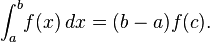
So we use that theorem to find the value of c in the following slides.
The final slide has a problem involving the Fundamental Theorem of Calculus. It says that if you integrate a function from a to b, the answer is the change in value of the function, f(b) - f(a). So that makes sense, we are given a rate of change, and in this case the rate at which oil is leaking. So when we integrate the function for the first 10 hours we get a number, and that number represents how much oil has leaked out.
That is it. Watch the video at the end of the slides for a little review on the Mean Value Theorem.
We will be continuing our discussion on the Intermediate Value Theorem of Integrals tomorrow, I believe.
Next Scribe will be Joyce. (Sorry for the confusion on my last scribe post)
Good Night and may the force be with you.
Tuesday, February 24, 2009
Working with the Absolute Values
Hello everyone,
My name is Ben and I'll be your scribe for today.
We started off with a very awkward question. We were asked to find the displacement of a car driving East or West from a certain place, but the question itself was unsolvable (is that a word? Anyways,). We saw that it was unsolvable because we weren't given a function or some sort of thing to represent the changes in velocity over the trip. The car could have been moving in one direction and back the same distance or it could have been moving in only one direction.
Then the next slide gave us our velocity function to find the displacement. We just used basic integration and found the displacement. Notice that we can actually find out where the object was. Normally if you were to integrate a velocity function you would only have a change in position with no exact location. We were given a reference point or a starting point so we can find out where it was after the given amount of time.
The next few slides involved the same type of work. Integrate the function to find the change in position or displacement.
Then we were asked to find the total distance of an object's travels. Note that we were supposed to find the DISTANCE. To find the distance we integrate the absolute value of the function.
The next slide was a generalization or a "What did we learn today" slide. Technically we didn't learn anything new because we already did it in chapter 6 I believe but it was a refresher.
If you integrate a velocity function you will find a change in position, it can be negative or positive or even zero depending on the direction of movement. If we were to integrate the absolute value of the velocity function we would get the total distance. If you were to take the absolute value of the integration of the velocity function you just get the change in position but it will be positive. I'm not sure if there is a use for that type of technique but I hope we talk about it tomorrow.
Homework is Chapter 18.1 Exercises 1-15 odd. The next scribe will be Paul which is not Not Paul but Francis, but by Francis I mean Not Paul.....................
My name is Ben and I'll be your scribe for today.
We started off with a very awkward question. We were asked to find the displacement of a car driving East or West from a certain place, but the question itself was unsolvable (is that a word? Anyways,). We saw that it was unsolvable because we weren't given a function or some sort of thing to represent the changes in velocity over the trip. The car could have been moving in one direction and back the same distance or it could have been moving in only one direction.
Then the next slide gave us our velocity function to find the displacement. We just used basic integration and found the displacement. Notice that we can actually find out where the object was. Normally if you were to integrate a velocity function you would only have a change in position with no exact location. We were given a reference point or a starting point so we can find out where it was after the given amount of time.
The next few slides involved the same type of work. Integrate the function to find the change in position or displacement.
Then we were asked to find the total distance of an object's travels. Note that we were supposed to find the DISTANCE. To find the distance we integrate the absolute value of the function.
The next slide was a generalization or a "What did we learn today" slide. Technically we didn't learn anything new because we already did it in chapter 6 I believe but it was a refresher.
If you integrate a velocity function you will find a change in position, it can be negative or positive or even zero depending on the direction of movement. If we were to integrate the absolute value of the velocity function we would get the total distance. If you were to take the absolute value of the integration of the velocity function you just get the change in position but it will be positive. I'm not sure if there is a use for that type of technique but I hope we talk about it tomorrow.
Homework is Chapter 18.1 Exercises 1-15 odd. The next scribe will be Paul which is not Not Paul but Francis, but by Francis I mean Not Paul.....................
Monday, February 23, 2009
Post Antiderivatives Test
Another test over with. Was it me or was that test extremely long? I barely had enough time to finish it. I completed all of the long answers (1st one was a doozy). The multiple choice took the longest overall because there was like 4 pages of them. But I was well prepared for the types of questions. I wasn't expecting that long of a test.
Enough about me. How about everyone else? How did you think you did on the test? What were the hard parts? Easy Parts?
Enough about me. How about everyone else? How did you think you did on the test? What were the hard parts? Easy Parts?
Friday, February 20, 2009
BOBBing
Hi Everyone,
Unfortunately I am going to miss the test because I am attending S.E.T 2009 at U of M. I was given permission to write the test on Monday during my spare.
This unit was quite fun because I got to play around with equations like in grade 12 Pre-Calculus in the Logarithm and Trig Identities unit. The hardest integrals to evaluate were the inverse trigonometic functions like arctan and arcsin because when they appear in a question, you have to write it in a way that fits the actual derivative or antiderivative. But with a little time and clever factoring the question can be solved.
The most useful thing that I learned in this unit was the substitution technique where we had to substitute a function as a variable. It was very funny how Mr K explained how to use the technique because it always sounded like some sort of motivational speaking. Jamie knows what I'm talking about.
That is my BOB for the Antiderivatives unit. Sorry Mr.K for not informing you about my absence earlier but I informed Dr. Eviatar. Hopefully you are okay with that Mr. K.
Good Night and wish me luck on Monday :D
Unfortunately I am going to miss the test because I am attending S.E.T 2009 at U of M. I was given permission to write the test on Monday during my spare.
This unit was quite fun because I got to play around with equations like in grade 12 Pre-Calculus in the Logarithm and Trig Identities unit. The hardest integrals to evaluate were the inverse trigonometic functions like arctan and arcsin because when they appear in a question, you have to write it in a way that fits the actual derivative or antiderivative. But with a little time and clever factoring the question can be solved.
The most useful thing that I learned in this unit was the substitution technique where we had to substitute a function as a variable. It was very funny how Mr K explained how to use the technique because it always sounded like some sort of motivational speaking. Jamie knows what I'm talking about.
That is my BOB for the Antiderivatives unit. Sorry Mr.K for not informing you about my absence earlier but I informed Dr. Eviatar. Hopefully you are okay with that Mr. K.
Good Night and wish me luck on Monday :D
Thursday, February 5, 2009
Workshop Day on an Optional Calc Day
Hello everyone, it is me Benofschool today otherwise known as Ben
Today was our first official unofficial calculus class. You can take that how ever you want. So today we had a workshop class. We all received a worksheet with various antiderivative skill testing questions. A function that we had to antidifferentiate was:

While working on the questions, one question brought us to a lesson on finding the antiderivative of lnx.
The way to find it can be found on the slides, but I'll upload it anyways.

To find the antiderivative of lnx we used integration by parts. The processed used to find it is very ingenius. According to the LIATE rule from last class, we pick lnx as f because if we picked it as g' we couldn't antidifferentiate it. If we did why would I be going through this tutorial. Anyways. we chose lnx for f and for g', oh no there is nothing to pick. Oh yes there is, there is a 1, it's just that we don't write it because number multiplied by 1 is itself. Let's recap, f will be lnx, and g' will be 1. Differentiate lnx and then antidifferentiate 1. With that done, the rest is just applying the integration by parts.
In the end we derived a general formula for finding the antiderivative of lnx. It can be found on the slide. But I won't upload it because you shouldn't memorize it because it is better if you antidifferentiate by hand using the technique shown above unless you are Mr K and you've taught how to antidifferentiate lnx so many times that you remember it by heart.
That's all we did today. I don't know if that worksheet was for homework but I'd do it just in case. The next scribe will be zeph.
Good Night.
Today was our first official unofficial calculus class. You can take that how ever you want. So today we had a workshop class. We all received a worksheet with various antiderivative skill testing questions. A function that we had to antidifferentiate was:
While working on the questions, one question brought us to a lesson on finding the antiderivative of lnx.
The way to find it can be found on the slides, but I'll upload it anyways.

To find the antiderivative of lnx we used integration by parts. The processed used to find it is very ingenius. According to the LIATE rule from last class, we pick lnx as f because if we picked it as g' we couldn't antidifferentiate it. If we did why would I be going through this tutorial. Anyways. we chose lnx for f and for g', oh no there is nothing to pick. Oh yes there is, there is a 1, it's just that we don't write it because number multiplied by 1 is itself. Let's recap, f will be lnx, and g' will be 1. Differentiate lnx and then antidifferentiate 1. With that done, the rest is just applying the integration by parts.
In the end we derived a general formula for finding the antiderivative of lnx. It can be found on the slide. But I won't upload it because you shouldn't memorize it because it is better if you antidifferentiate by hand using the technique shown above unless you are Mr K and you've taught how to antidifferentiate lnx so many times that you remember it by heart.
That's all we did today. I don't know if that worksheet was for homework but I'd do it just in case. The next scribe will be zeph.
Good Night.
Tuesday, January 20, 2009
Post Integrals Again Test
That may be a confusing title, but it wasn't as confusing as some of the questions. I totally underestimated the test (my bad). The multiple choice questions were quite simple. Some took longer to solve, but in the end it wasn't that bad. The Free Response questions were on a whole different level.
The first one that involved the the functions composed of many other functions was quite confusing. I don't know if I got the right answer, but I think my work got me some part marks I hope. The second Free Response question was a bit easier. It asked for the area enclosed by the y-axis and the function. Yes, I said y-axis. I remembered that for the inverse of a function, the x-axis of the parent function is it's y-axis and vice versa. So I used that to find the area function.
Okay that is all that I had to say about that test. So I want to hear what everyone else thought of the test. What were the easy parts? Hard parts? Also if you want to contribute with your thoughts on how you solved the questions, feel free to do so.
See you all tomorrow.
The first one that involved the the functions composed of many other functions was quite confusing. I don't know if I got the right answer, but I think my work got me some part marks I hope. The second Free Response question was a bit easier. It asked for the area enclosed by the y-axis and the function. Yes, I said y-axis. I remembered that for the inverse of a function, the x-axis of the parent function is it's y-axis and vice versa. So I used that to find the area function.
Okay that is all that I had to say about that test. So I want to hear what everyone else thought of the test. What were the easy parts? Hard parts? Also if you want to contribute with your thoughts on how you solved the questions, feel free to do so.
See you all tomorrow.
Monday, January 19, 2009
Almost forgotten BOB
I almost forgot to BOB. Thankfully Francis reminded me. This unit was quite easy. The BOB for this Integral unit might be a bit short. My favourite part about this unit was evaluating the integrals of functions and the accumulation functions. After that Pre-Test (Revised) I felt like I was prepared for this test. The only problem is the time. If I had about 5 more minutes I think I would've completed that Pre-Test. The test is about twice as long as the Pre-Test, so after doing some calculations the one hour should be more than enough time for the test.
That was my BOB and good luck tomorrow.
That was my BOB and good luck tomorrow.
Monday, January 12, 2009
Accumulating All We Learned About Accumulation Functions Accumulatively
Hi everyone,
I'll be your scribe for today.
Today we began with talking about Googling ourselves. Remember that every time we post something anywhere at anytime on the internet, we are leaving an online "footprint". Mr.K used an example when someone would search your name on Google or on any other online search engine. If an employer or future employer were to search your name online, would they find anything that you do not want to be known about yourself? So becareful with what you leave online, just incase someone searches you up online.
Okay back to math.

We began with a little reminder about what the Inequality Rule of Integrals was about. The Rule says that if a function, for example, f(g) ≤ g(x), than between the same intervals, the integral of f(x) is also less than or equal to the integral of g(x). Refer to the image above for a visual.
Introducing the mighty Obi-Wan Kenobi. Just so everyone knows Darth Vader is better, and if he had Darth Maul's Double Lightsaber, he would own everyone.

On this slide we applied the Fundamental Theorem of Calculus (FTC). If you want more info on the FTC then click here. But I'll explain it anyways. The fundamental theorem says that the integral of any function is equal to the total change in output (y-values) of the antiderivative function. For example if you take the integral of a velocity function/curve, it is also equal to the change in position of the object moving. The downside to this is that we won't know where the object is or where it began, but only how far it moved.
So to solve the problem we have to realize that we are looking for a change in values on the antiderivative of th given function. That is the Fundamental Theorem of Calculus. So what we can do is apply the constant multiple rule to make some antidifferentiating a little light for us. Then we apply the Fundamental Theorem of Calculus. So we have to find the antiderivative of the function. Once that is done we can find the total sales between year 2 and year 4. Remember that we cannot have part sales so we have to round down to the nearest integer for the final answer.

This next part is the introduction of a new topic in the unit of integrals. But it isn't really a new topic because it is putting some visuals to the antiderivatives. The function on the above slide may be a bit ugly but I'll pick out the little things to make bit nicer. Well the function involves 2 variables, x and t. t is the independent variable in the inner function, f, and x is the independant variable for the outside function, A. Since f is a function that is a nice and smooth function so we don't have to worry about any conflicts with arguements. So is the interval of the integral of the integrand, f(t). The variable, x, increases or decreases the size of the interval of the integral. So we were told to fill in the tables on the slide. For each value of x the size of the interval increases or decreases changing the integral of f(t). Since f(t) is a straight line, we can just count squares and triangles.
Oh no you have just ran into an area below the x-axis. What do you do? I'll tell you. Notice that there is a negative change in x and also a negative change in y. So the area can be multiplied by multiplying the y value and x value depending on either the area is a triangle or rectangle. So when you multiply a negative by a negative, you get a positive.
Now let`s graph the numbers found. Notice that it forms a parabola. This should make sense because the antiderivative of a line is a parabola.

That little experiment brought us to the Sign Convention. No there is no event at the MTS Centre about signs, but a sign rule. The convention says that the integral of a function is equal to the negative of the integral of the same function if the interval is reversed.


The next two questions involve the same process as the experiment from earlier. Notice that the fixed interval endpoint is changed in each question.
That was my scribe. As you can see on the last image written by Lawrence with his left hand, homework is Exercise 6.2 all odd questions and omit questions 7 and 11.
The next scribe will be Joyce.
Good night, I got to get studying. I have a lot of APs to study for.
I'll be your scribe for today.
Today we began with talking about Googling ourselves. Remember that every time we post something anywhere at anytime on the internet, we are leaving an online "footprint". Mr.K used an example when someone would search your name on Google or on any other online search engine. If an employer or future employer were to search your name online, would they find anything that you do not want to be known about yourself? So becareful with what you leave online, just incase someone searches you up online.
Okay back to math.

We began with a little reminder about what the Inequality Rule of Integrals was about. The Rule says that if a function, for example, f(g) ≤ g(x), than between the same intervals, the integral of f(x) is also less than or equal to the integral of g(x). Refer to the image above for a visual.
Introducing the mighty Obi-Wan Kenobi. Just so everyone knows Darth Vader is better, and if he had Darth Maul's Double Lightsaber, he would own everyone.

Look at all of his strength.

On this slide we applied the Fundamental Theorem of Calculus (FTC). If you want more info on the FTC then click here. But I'll explain it anyways. The fundamental theorem says that the integral of any function is equal to the total change in output (y-values) of the antiderivative function. For example if you take the integral of a velocity function/curve, it is also equal to the change in position of the object moving. The downside to this is that we won't know where the object is or where it began, but only how far it moved.
So to solve the problem we have to realize that we are looking for a change in values on the antiderivative of th given function. That is the Fundamental Theorem of Calculus. So what we can do is apply the constant multiple rule to make some antidifferentiating a little light for us. Then we apply the Fundamental Theorem of Calculus. So we have to find the antiderivative of the function. Once that is done we can find the total sales between year 2 and year 4. Remember that we cannot have part sales so we have to round down to the nearest integer for the final answer.

This next part is the introduction of a new topic in the unit of integrals. But it isn't really a new topic because it is putting some visuals to the antiderivatives. The function on the above slide may be a bit ugly but I'll pick out the little things to make bit nicer. Well the function involves 2 variables, x and t. t is the independent variable in the inner function, f, and x is the independant variable for the outside function, A. Since f is a function that is a nice and smooth function so we don't have to worry about any conflicts with arguements. So is the interval of the integral of the integrand, f(t). The variable, x, increases or decreases the size of the interval of the integral. So we were told to fill in the tables on the slide. For each value of x the size of the interval increases or decreases changing the integral of f(t). Since f(t) is a straight line, we can just count squares and triangles.
Oh no you have just ran into an area below the x-axis. What do you do? I'll tell you. Notice that there is a negative change in x and also a negative change in y. So the area can be multiplied by multiplying the y value and x value depending on either the area is a triangle or rectangle. So when you multiply a negative by a negative, you get a positive.
Now let`s graph the numbers found. Notice that it forms a parabola. This should make sense because the antiderivative of a line is a parabola.

That little experiment brought us to the Sign Convention. No there is no event at the MTS Centre about signs, but a sign rule. The convention says that the integral of a function is equal to the negative of the integral of the same function if the interval is reversed.


The next two questions involve the same process as the experiment from earlier. Notice that the fixed interval endpoint is changed in each question.
That was my scribe. As you can see on the last image written by Lawrence with his left hand, homework is Exercise 6.2 all odd questions and omit questions 7 and 11.
The next scribe will be Joyce.
Good night, I got to get studying. I have a lot of APs to study for.
Saturday, January 10, 2009

Wednesday, January 7, 2009
Post Test for Applications of Derivatives
Another day and another test.
Time for another round of thoughts and reflections on the last test.
I'll start it off. This test was quite tough being that it was the first test back from the long winter holidays. The multiple choice questions were much more challenging compared to the free response questions. The last few multiple choice questions were a tad easier.
For the free response, the optimization problem was extremely easy (I was happy when I saw the question). The other free response question took a bit longer to answer. I was not 100% sure if the given function contained a cusp or a curve. I was unsure because of the resolution and pixels of the picture because it was taken from a TI Calculator. So I asked Mr. K for what it was and all I hear was curve, so I took that word for it and continued to answer the question with the function having no cusp.
That was my reflection. I want to know how everyone else thought about the test. Was it easy? Hard? Muddy? Clear? Was it Hot? Was it Cold? Is that a Yes or a No? Come in and answer, don't stay out. What were your ups? What were your downs?
Time for another round of thoughts and reflections on the last test.
I'll start it off. This test was quite tough being that it was the first test back from the long winter holidays. The multiple choice questions were much more challenging compared to the free response questions. The last few multiple choice questions were a tad easier.
For the free response, the optimization problem was extremely easy (I was happy when I saw the question). The other free response question took a bit longer to answer. I was not 100% sure if the given function contained a cusp or a curve. I was unsure because of the resolution and pixels of the picture because it was taken from a TI Calculator. So I asked Mr. K for what it was and all I hear was curve, so I took that word for it and continued to answer the question with the function having no cusp.
That was my reflection. I want to know how everyone else thought about the test. Was it easy? Hard? Muddy? Clear? Was it Hot? Was it Cold? Is that a Yes or a No? Come in and answer, don't stay out. What were your ups? What were your downs?
Tuesday, January 6, 2009
BOB for Chapter Five
Darn, that break really messed me up. Before the break I felt like I was on a roll with the questions in the chapter. Now that I look at the questions one last time before the test, I feel like I'm almost new to the subject. What I do remember from "Last Year" was the Mean Value Theorem, some Optimization Problems, and How to use the First and Second Derivatives.
The Mean Value Theorem says that if a function is differentiable and continuous within a closed interval, the secant line connecting the 2 endpoints of the function will have a slope equal to, at least, one other tangent line of another point on that function within the interval.
Optimization Problems are word problems involving situations where you want to have the most or least of something. Some examples include maximizing number products sold while minimizing production costs, or maximizing the area of a shape inscribed another shape with limited dimensions.
The main point of this chapter is to learn the many uses of the First and Second Derivatives.
The First Derivative can be used to find many things about the parent function, but the main use is to find the critical point(s) of the parent function that may exist and on what interval(s) is the parent function is increasing or decreasing. Critical Points include Local/Global Maxima (Max or Mins).
The main use of the Second Derivative is to find on which interval(s) is the parent function concave up or down and where the parent function has an inflection point (change in concavity).
Once I saw the word Antiderivatives again after the break, everything that we learned "Last Year" flew back into my head. *That was the coolest flashback I ever had.
To antidifferentiate a function is to find the parent function if the first derivative is given, the first derivative if the second derivative is known, etc.
Overall I think I'm going to do okay. It may take me a while to complete it though.
Good luck and see you all tomorrow.
The Mean Value Theorem says that if a function is differentiable and continuous within a closed interval, the secant line connecting the 2 endpoints of the function will have a slope equal to, at least, one other tangent line of another point on that function within the interval.
Optimization Problems are word problems involving situations where you want to have the most or least of something. Some examples include maximizing number products sold while minimizing production costs, or maximizing the area of a shape inscribed another shape with limited dimensions.
The main point of this chapter is to learn the many uses of the First and Second Derivatives.
The First Derivative can be used to find many things about the parent function, but the main use is to find the critical point(s) of the parent function that may exist and on what interval(s) is the parent function is increasing or decreasing. Critical Points include Local/Global Maxima (Max or Mins).
The main use of the Second Derivative is to find on which interval(s) is the parent function concave up or down and where the parent function has an inflection point (change in concavity).
Once I saw the word Antiderivatives again after the break, everything that we learned "Last Year" flew back into my head. *That was the coolest flashback I ever had.
To antidifferentiate a function is to find the parent function if the first derivative is given, the first derivative if the second derivative is known, etc.
Overall I think I'm going to do okay. It may take me a while to complete it though.
Good luck and see you all tomorrow.
Wednesday, December 17, 2008
Math Fun
Here are some videos I found on Youtube. Its fun trust me :P
I don't persinally use this but it is cool...
http://www.youtube.com/watch?v=9qQAYEYLCoU
http://www.youtube.com/watch?v=I9t-gYnPNaw
http://www.youtube.com/watch?v=IIwlBjNLpjI
His profile:
http://www.youtube.com/user/glad2teach
That's all =D
I don't persinally use this but it is cool...
http://www.youtube.com/watch?v=9qQAYEYLCoU
http://www.youtube.com/watch?v=I9t-gYnPNaw
http://www.youtube.com/watch?v=IIwlBjNLpjI
His profile:
http://www.youtube.com/user/glad2teach
That's all =D
Subscribe to:
Posts (Atom)